


Value engineering in construction is all about a systematic, creative approach to getting the most bang for your buck on a project. It’s a deep dive into analyzing the function of every component, not just blindly slashing costs. The goal is to deliver the best possible performance for the lowest lifecycle cost, making sure every dollar spent genuinely adds to the project's worth.
Think of it like a master chef tweaking a recipe. Instead of just swapping in cheaper ingredients and hoping for the best, they might discover a new cooking technique that delivers an even better flavor while saving time and money. That’s value engineering in a nutshell.
Unpacking the True Meaning of Value

It's a common misconception that value engineering is just a fancy term for cost-cutting. While saving money is often a happy byproduct, it's not the main objective. Real value engineering is a proactive strategy focused on function, aiming to boost a project's overall value without ever compromising on quality, reliability, or safety.
The entire process boils down to a simple but powerful ratio: Value = Function / Cost.
This little formula gives us three clear paths to increasing a project's value:
- Improve Function: Boost a component's performance without letting the cost go up.
- Reduce Cost: Find a more affordable way to achieve the very same function.
- Do Both: The grand prize—improve the function and lower the cost at the same time.
To better understand this, let's break down the key ideas that drive this process.
Core Concepts of Value Engineering at a Glance
| Concept | Description | Example in Construction |
|---|---|---|
| Function Analysis | The heart of VE. It's about identifying what a component does, not just what it is. | Instead of "we need a steel I-beam," the team asks, "what is the best way to support this 5-ton load over a 20-foot span?" |
| Lifecycle Cost | Looking beyond the initial price tag to consider the total cost of ownership, including maintenance, operations, and eventual disposal. | Choosing slightly more expensive, energy-efficient HVAC units that will save the owner tens of thousands in utility bills over the building's life. |
| Value-to-Cost Ratio | A quantitative way to measure how much function you get for every dollar spent. The goal is always to maximize this ratio. | Comparing a pre-cast concrete panel system to a traditional masonry wall to see which provides the necessary structural support and insulation for less money. |
| Creative Problem-Solving | Encourages brainstorming and out-of-the-box thinking from a multidisciplinary team to generate innovative solutions. | A team might suggest reorienting the building on the site to maximize natural light, reducing the need for expensive artificial lighting systems. |
By focusing on these principles, teams can move beyond simple cost-cutting and make genuinely smarter decisions.
Value engineering is a systematic methodology designed to ensure that project owners are not overpaying for quality when equally effective, less expensive alternatives exist. This disciplined approach is critical for maintaining profitability.
Shifting Focus from Components to Function
Instead of just looking at a steel beam and asking, "Can we find cheaper steel?" a value engineering team asks, "What is the function of this beam, and is there a fundamentally better way to support this load?" This simple shift in thinking opens up a world of possibilities, leading to innovative designs, new materials, or different construction methods that might do the job even better.
This mindset is more important than ever as the global construction industry grapples with intense pressure on cost management. With global construction spending soaring past USD 2 trillion in recent years, finding ways to optimize costs without sacrificing quality is essential for staying competitive. You can find more details on how VE ensures owners don't overpay for quality on gordian.com.
Ultimately, value engineering is a direct challenge to the "this is how we've always done it" mentality. It champions a collaborative, creative, and analytical process where architects, engineers, and contractors put their heads together. They work to identify and eliminate unnecessary costs tied to parts of the project that don't add to its core function, ensuring the final building is as efficient and effective as it can possibly be.
The Guiding Principles of Value Engineering
At its heart, value engineering (VE) is much more than just a line-by-line budget review. It’s a completely different way of thinking, guided by a set of principles that force a shift from asking "what is this?" to "what does this do?" This simple change in perspective is what produces incredible results, ensuring you get the absolute best performance for every dollar spent.
A central idea is the relentless focus on function over components. Think about it this way: instead of getting fixated on the specs of a specific steel beam, a VE team asks a more fundamental question: "What load does this beam need to support, and what’s the smartest way to do that?" That question alone opens the door to exploring different materials, fresh designs, or more efficient construction techniques that get the exact same job done, often for less money.
Another pillar of VE is the multi-disciplinary team approach. The best ideas almost never come from a single person working alone. Real value engineering pulls architects, engineers, contractors, and even the project owner into the same room to combine their unique perspectives.
The Power of Collective Insight
This is where the real breakthroughs happen. An architect can spot a design opportunity, the engineer can confirm if it’s structurally sound, and a good contractor brings it all back to reality with on-the-ground insights about costs and buildability. This 360-degree view is what keeps expensive mistakes from happening and leads to genuinely creative and practical solutions.
Of course, this whole process hinges on having the right people in the room. You can learn more about what to look for in our guide on how to choose a contractor.
“To truly provide advantageous value engineering, your construction and design team need to first understand the project as a whole and your vision and goals for the project. Every project is different, as is every client’s definition of value.”
This principle—understanding the project’s goals first—is universal. It’s just as relevant in mature markets as it is in high-growth regions. The global construction industry is on track to hit USD 13.9 trillion by 2037, with a huge chunk of that growth coming from markets like China and India. Meanwhile, in established markets like the US and UK, value engineering becomes a key competitive edge for getting the most out of every single project. You can find more data on this in a report about the global architecture and engineering industry on benchmarkintl.com.
Core Tenets of the VE Philosophy
When you boil it all down, the philosophy behind value engineering rests on a few core beliefs that keep the process focused and effective:
- Prioritize Lifecycle Costs: This isn't just about the upfront construction price tag. The analysis has to account for the long-term costs of running, maintaining, and eventually replacing systems. A cheaper HVAC unit today could end up costing a fortune in energy bills and repairs over the building's lifespan.
- Maintain Essential Quality: VE is not about cutting corners. It never means sacrificing quality, safety, or performance. The entire point is to hunt down and eliminate unnecessary costs—the expenses that add nothing to what the project truly needs to do.
- Embrace Creative Thinking: The process is designed to challenge the "we've always done it this way" mentality. During brainstorming, no idea is a bad idea. This creates an atmosphere where innovative, and sometimes surprising, solutions can be found and seriously considered.
How the Value Engineering Job Plan Works
Value engineering in construction isn't magic; its success comes from a structured, repeatable process called the Job Plan. Think of it less like a single brainstorming session and more like a systematic, multi-phase workshop designed to squeeze every drop of value out of a project. It gives the entire team a clear roadmap to follow.
It all starts with the Information Phase. This is the deep-dive stage where the team gets completely immersed in the project. They gather every relevant document—design plans, specs, cost breakdowns, and budget constraints—to fully grasp the project's goals and the owner's vision before a single change is even considered. Solid documentation here is crucial, which is why a well-defined framework, much like you'd find in a residential construction contract template, helps set the stage for a successful outcome.
Once everyone is on the same page, the process moves into its most critical stages.
Function Analysis and Creative Brainstorming
Next up is the Function Analysis Phase, which is really the heart and soul of value engineering. Here, the team breaks down every single component of the project to its absolute core functions. These are often labeled as primary (what it must do) or secondary (what it also does). For instance, a wall's primary function is to support the roof. A secondary function might be to provide sound insulation. By assigning a cost to each of these functions, the team can immediately spot where big money is being spent on things that aren't absolutely essential.
This analytical work flows right into the Creative Phase. Armed with a crystal-clear understanding of what each part does, the team lets the ideas fly. This is pure, unfiltered brainstorming where the only rule is that no idea is a bad idea. The goal is to encourage innovative, out-of-the-box thinking to find new materials, methods, or designs that can perform the same function for less cost or with better performance.
The infographic below really captures the principles that make this collaborative process tick.
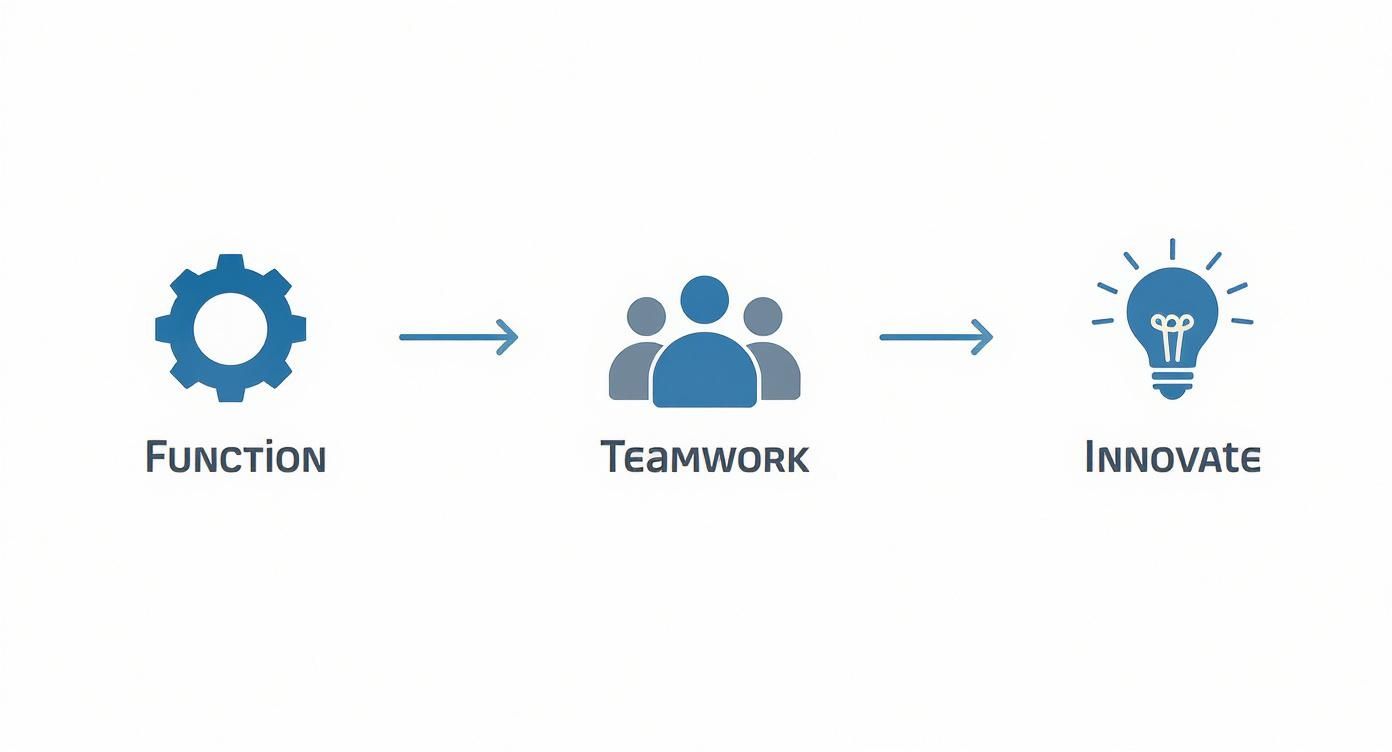
As you can see, it's that intense focus on function, fueled by teamwork, that sparks the kind of game-changing solutions that come out of the Job Plan.
Evaluation and Final Presentation
After the creative free-for-all comes the Evaluation Phase, where the ideas get a reality check. The team systematically weighs each alternative against a checklist of criteria: cost, feasibility, risk, and long-term performance. Ideas that seemed brilliant on the whiteboard are now rigorously vetted to make sure they're actually practical and won't compromise the project's quality standards.
The best of the bunch then graduate to the Development Phase. This is where the team rolls up its sleeves and turns promising ideas into detailed, actionable proposals. Each one is fleshed out with revised plans, clear cost-benefit analyses, and all the data needed to make an informed decision.
This structured approach ensures that recommendations aren't just creative whims. They are thoroughly researched, practical, and backed by solid data, which makes them far more compelling to project stakeholders.
Finally, it all comes together in the Presentation Phase. The refined proposals are formally presented to the project owner and other key decision-makers. The presentation walks them through the original design, explains the proposed changes, and clearly spells out the expected benefits—all with a sharp focus on how each recommendation boosts the project's overall value. Once the green light is given, the changes are woven into the project plan, and the team keeps an eye on implementation to ensure the promised savings and performance gains become a reality.
Real-World Examples of Value Engineering in Action

The theory behind value engineering is great, but the real "aha" moment comes when you see it work on an actual job site. That’s when the concepts truly click. These real-world stories show how asking "what is the function?" can completely reshape a project, saving a ton of money while often making the final product even better.
Rethinking the Structure of an Office Tower
Picture a new multi-story office building going up in a dense city center. The initial plans called for a conventional steel frame—the go-to, reliable choice, but also an expensive one. During a value engineering workshop, the team stepped back and asked a foundational question: "What does the structural system actually need to do?" The simple answer was to safely support the building's weight.
That function-first mindset cracked the door open for new ideas. The team ended up proposing a post-tensioned concrete slab system. Yes, it required bringing in a specialized subcontractor, but a detailed analysis showed it would drastically cut the amount of concrete and reinforcing steel needed.
The result? A staggering $1.5 million was shaved off the structural costs, and the simpler formwork even sped up the construction schedule.
Swapping Systems for Long-Term Performance
Value engineering isn't just about the big structural pieces. It often delivers its biggest wins by improving a building's operational systems, saving money for decades to come.
Take a large hospital project, for instance. The original design featured a standard HVAC system with rooftop air handlers. The VE team, however, looked beyond the initial price tag and analyzed the building's full lifecycle cost, specifically focusing on energy and maintenance over a 30-year span.
Their alternative? A geothermal heat pump system. This meant drilling wells and a higher upfront cost, no doubt. But their lifecycle analysis was crystal clear: this system would slash the hospital's annual energy bills.
The proposal laid out some compelling benefits:
- Massive Energy Reduction: The geothermal system was projected to use 40% less energy than the conventional design, translating into millions of dollars in savings over the life of the building.
- Lower Maintenance: With most major components buried underground, the system was protected from the elements, meaning fewer repairs down the road.
- Better Environment for Care: Geothermal systems provide exceptionally stable indoor temperatures, creating a more comfortable and healing environment for patients and staff.
The project owner saw the wisdom in the numbers and approved the change. It was a perfect case of prioritizing the total cost of ownership over a lower initial price tag, recognizing the higher upfront cost would pay for itself in just a few years.
Finding Smarter Materials to Solve Bigger Problems
Sometimes, the value engineering process points toward newer materials that create a cascade of positive effects. On a major bridge replacement, the design specified traditional steel girders. A VE study challenged this standard practice by focusing on the core function: providing a durable, corrosion-resistant crossing for vehicles.
The team came back with a suggestion to use fiber-reinforced polymer (FRP) composite girders instead. These materials were not only lighter than steel but also completely immune to rust—a huge problem in the region's climate.
This single change sent ripples through the entire project. Because the FRP girders were so much lighter, the support piers and foundations could be smaller and less costly. The installation could be done with smaller cranes, which cut equipment costs and sped up the whole timeline.
In the end, they built a more durable, lower-maintenance bridge, and they did it faster and for less money. That’s value engineering at its best.
Weighing the Benefits and Common Hurdles
Bringing value engineering into a project can be a game-changer, but it’s no magic wand. To really make it work, you have to understand both its incredible upsides and the real-world obstacles you'll likely face. When done right, VE is about much more than just cutting the budget—it’s about building smarter.
The headline benefit everyone talks about is a major drop in lifecycle costs. Instead of fixating on the initial price tag, VE takes the long view, factoring in everything from future maintenance and energy bills to eventual replacement costs. This ensures that the savings you find today don't turn into a massive headache down the road.
This forward-thinking mindset naturally leads to better project performance and quality. When teams are encouraged to question the function of every single component, they often unearth better materials or more efficient systems that boost durability and make the building work better for its occupants.
The Upside of a Disciplined Approach
Beyond the big-picture savings, value engineering brings practical improvements to how a project gets built. A solid VE workshop often delivers:
- A Tighter Schedule: Identifying smarter building methods or alternative materials can shave valuable time off the construction schedule and simplify tricky phases.
- A Spark of Innovation: The collaborative brainstorming sessions push everyone to challenge old habits and think outside the box, creating a genuine problem-solving culture.
- Crystal-Clear Requirements: The deep dive into function analysis gets everyone on the same page about what the project truly needs to accomplish.
This kind of disciplined focus is more important than ever. With U.S. construction spending hitting USD 1.98 trillion—a 7.4% jump in just one year—and the global market expected to reach USD 20,446.85 billion by 2029, the pressure to control costs is immense. As detailed in these construction industry statistics on Autodesk's blog, VE offers a proven way to protect your margins.
Navigating the Common Challenges
Of course, for all its benefits, rolling out a value engineering process isn't always a walk in the park. One of the biggest hurdles is simply resistance to change. Designers and contractors often get attached to their go-to methods and can sometimes see VE suggestions as a critique of their original work.
Another major challenge is shaking the myth that VE is just a fancy term for making things cheaper. Getting past this requires clear and consistent communication that the goal is to improve value, not just slash costs. A key part of this is showing how proposed changes maintain or even improve quality, which is where tools like a comprehensive construction quality control checklist become invaluable.
It’s easy to see why some teams are skeptical, but the reality is often the opposite of what they fear.
Value Engineering Benefits vs Common Misconceptions
This table directly compares the proven advantages of value engineering with some of the most frequent misunderstandings that can hold a project back.
| Proven Benefit | Common Misconception |
|---|---|
| Reduces total lifecycle costs by analyzing long-term expenses. | It's all about slashing the initial budget, regardless of future costs. |
| Enhances project quality by finding better materials and systems. | It cheapens the project by substituting with inferior products. |
| Fosters innovation and creative problem-solving among the team. | It stifles creativity by forcing designers to compromise their vision. |
| Improves function and performance to meet user needs better. | It eliminates important features that clients wanted. |
Ultimately, a well-executed VE process adds value without sacrificing the project's core integrity.
The single most critical factor for success is timing. Value engineering delivers its biggest punch when it happens early in the design phase. If you wait until construction is already underway, your options become severely limited, and any changes will be far more expensive and disruptive.
By anticipating these hurdles and championing the process with a balanced perspective, project leaders can navigate the challenges and unlock the full potential of value engineering.
Common Questions About Value Engineering
Even after laying out the whole process, a few key questions always pop up when we talk about value engineering on a real-world construction site. It’s a discipline where context is king, and the nuances matter. Let's tackle some of the most common ones to clear the air.
Think of this as a quick field guide to separate value engineering from simple cost-cutting and understand how to put it to work on your next build.
What Is the Difference Between Value Engineering and Cost Cutting?
This is easily the biggest point of confusion, and the difference is night and day. Cost cutting is all about reaction. The goal is simple: spend less money right now. This often means swapping in cheaper materials or just axing features altogether, which can seriously backfire and hurt the project’s quality and lifespan.
Value engineering is the complete opposite. It’s a proactive, systematic look at function. The whole point is to achieve every essential function for the lowest possible lifecycle cost, without ever compromising on quality, reliability, or safety.
Value engineering is a strategic analysis of function aimed at boosting overall value. Cost cutting is just a tactical move to reduce the upfront price tag.
Here’s a practical example. A cost-cutting move might be to replace the specified brand of windows with a cheaper, less efficient alternative. A value engineering approach would be to study the building's orientation and insulation first, then see if the total window area could be reduced—cutting costs while actually maintaining or even improving the building's energy performance.
When Is the Best Time to Perform Value Engineering?
With value engineering, timing is everything. The sweet spot is during the design and planning phase, ideally around the schematic design or early design development stage. The earlier you start, the bigger the potential for savings and improvements.
It’s a whole lot cheaper to make changes with an eraser than with a sledgehammer. At this early stage, you can explore major alternatives, like rethinking the structural system or reorienting the entire building on the lot, without triggering massive redesign costs or blowing up the schedule.
Sure, you can technically apply VE at any point, but its impact plummets as the project moves forward. Trying to do it during construction usually limits you to small-fry substitutions in materials or methods. You end up leaving the most significant opportunities for savings on the table.
Who Should Be on a Value Engineering Team?
A great value engineering workshop is all about bringing different perspectives into one room. If your team is one-sided, your results will be, too. For a truly well-rounded review, you need a mix of experts at the table.
Typically, the team should include:
- The Project Owner: Or a key representative who knows the project's vision inside and out.
- Architects and Designers: The people who created the initial concept.
- Engineers: Specialists in structural, mechanical, electrical, and plumbing (MEP) systems.
- The General Contractor: The boots-on-the-ground expert who understands construction methods.
- Key Subcontractors: Trade specialists who bring deep, practical knowledge.
- A Certified Facilitator: This is often a Certified Value Specialist (CVS) who can guide the process and keep the team focused.
It's this blend of experience and expertise that really sparks creative problem-solving and makes sure the ideas that come out of the workshop are both innovative and genuinely buildable.
At CJMC Build, we bring this same collaborative and value-driven mindset to every custom home we build in Nashville. We believe in building smarter, not just cheaper, ensuring your vision is realized with quality and integrity.
Start the conversation about your custom home project today.

