


You're at the finish line of a huge construction project. The dust is settling, the major work is done, and the space is almost ready. But "almost" isn't "done." This is where the punch list comes in—it’s the critical final checklist that bridges the gap between substantial completion and a truly finished project.
Your Guide to the Construction Punch List
Think of it as the final, detailed inspection. It’s a formal document listing every last task that needs to be fixed, tweaked, or touched up before the keys are officially handed over.
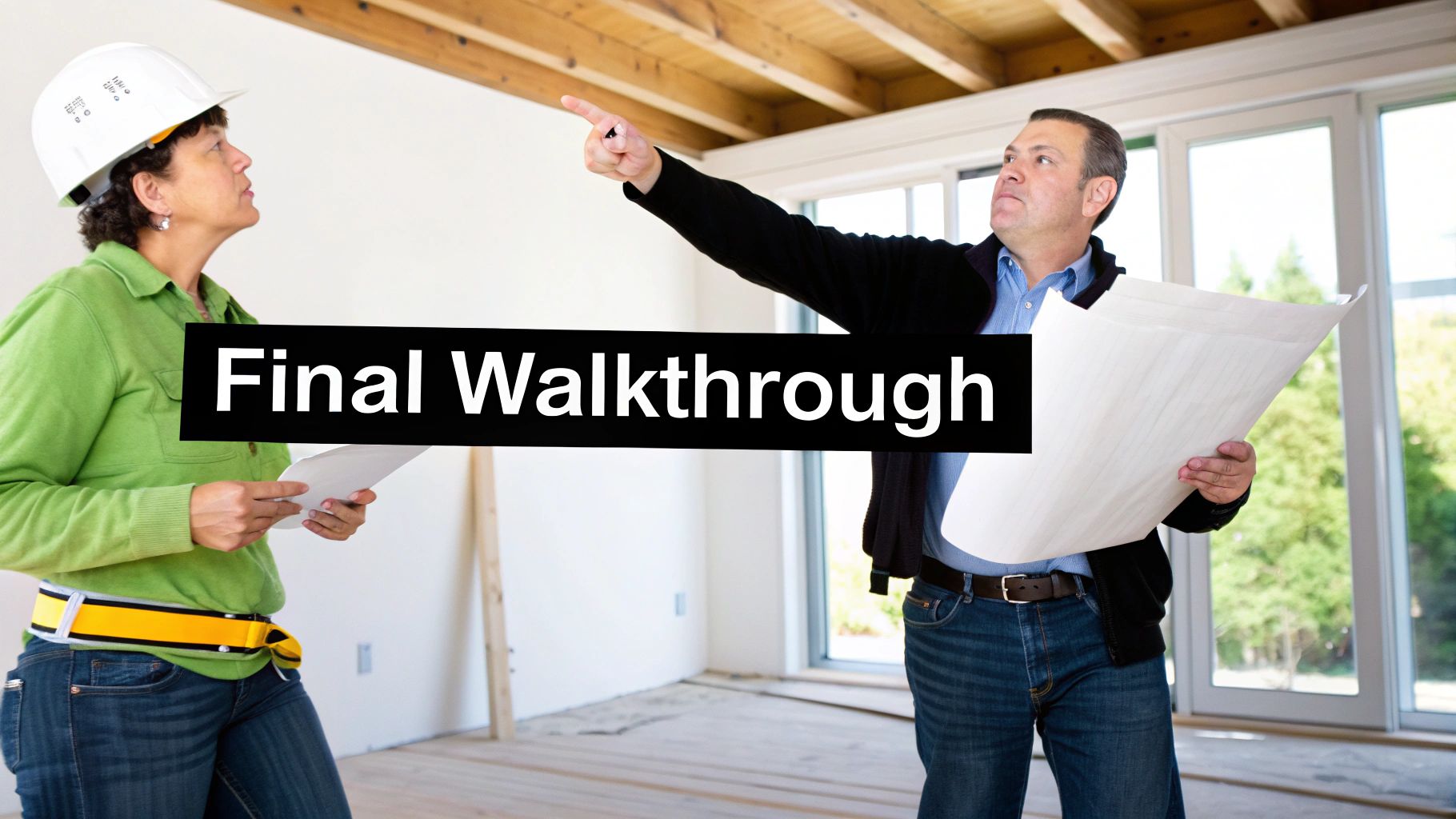
It’s a bit like buying a brand-new car. You wouldn't just jump in and drive off. You'd walk around it, check for any dings or scratches, and make sure every feature works perfectly. A punch list is the exact same concept for a building, just on a much bigger scale. It’s the organized process that ensures the final product meets the standards set out in the contract.
This list is typically born from a final walkthrough when the project hits substantial completion. That’s the point where the building is safe and functional enough for the owner to move in or use it for its intended purpose, even if a few minor things still need attention.
The Purpose of a Punch List
So, why is this process so important? At its core, the punch list is about making sure the client gets exactly what they paid for, down to the last detail. It’s the final quality control checkpoint.
Without a formal punch list, tiny imperfections—a paint scuff, a sticky door, a faulty light switch—can easily get missed. Those small issues can quickly add up, leading to unhappy clients, arguments over final payments, and expensive callbacks after everyone has packed up and left. A well-managed punch list turns that potential chaos into a smooth, professional closeout.
It provides a crystal-clear, documented record of what's left to do and serves a few vital roles:
- Quality Control: This is the last line of defense for quality, catching everything from a tiny scratch on a floorboard to a misaligned cabinet.
- Accountability: Every item on the list gets assigned to the right subcontractor. This creates clear ownership and ensures nothing gets overlooked. No finger-pointing, just clear responsibility.
- Financial Security: The completion of the punch list is almost always tied to the final payment and the release of retainage—a portion of the contract price held back to guarantee all work gets finished properly.
To make this easier to grasp, here’s a quick overview of what a punch list is all about.
Punch List Quick Reference Guide
| Aspect | Description |
|---|---|
| What It Is | A formal checklist of minor repairs, adjustments, and fixes required at the end of a construction project. |
| When It's Created | During a final walkthrough, once the project has reached "substantial completion." |
| Who's Involved | The general contractor, client/owner, architect, and relevant subcontractors. |
| Its Main Goal | To ensure the final build meets all contractual quality standards before final payment is made. |
Ultimately, this simple list makes all the difference in a project's final phase.
A punch list transforms the final, often chaotic, phase of a project into an organized, collaborative effort. It’s the definitive roadmap that guides a project across the finish line with precision and professionalism, ensuring every detail is addressed before the job is officially closed out.
Why the Punch List Is a Critical Closeout Milestone
Don't mistake a punch list for a simple to-do list. In the world of construction, it's a massive financial and legal milestone—the official bridge that takes a project from "mostly done" to 100% complete. It’s what stands between you and the final handover.
The process really kicks off when a project hits substantial completion. That’s the formal term for when a building is safe and functional enough for the owner to move in or use it as intended, even if minor touch-ups are still needed. The punch list is the master document that captures every single one of those remaining items.
Think of it as the final, exhaustive quality control inspection. It’s what ensures every last detail matches the blueprints and contract specs before the project is officially closed out. It turns vague feelings about "doneness" into a solid, actionable plan.
The Financial Stakes of the Punch List
One of the punch list's biggest teeth is its direct connection to the money—specifically, the release of retainage. This is a chunk of the total contract price, usually 5-10%, that the owner holds back from the contractor throughout the job.
This money is a powerful incentive. It acts as a financial guarantee, motivating the contractor to wrap up every last item to the owner's satisfaction. The punch list is the roadmap to getting those funds released.
A messy or slow punch list process can bring a contractor's cash flow to a dead stop. If completing those final items drags on, so does receiving that last, often very large, payment. You can bet that contractors are highly motivated to knock out every point on that list quickly and professionally.
A Tool for Alignment and Dispute Prevention
Beyond the dollars and cents, the punch list is a vital communication tool. It gets the owner, architect, and contractor in a room (literally or figuratively) to agree on what "finished" actually looks like. Getting everyone on the same page is crucial for avoiding those frustrating last-minute arguments.
By documenting everything—from a small paint scuff to a crooked light fixture—the list creates an objective, shared record of what needs to be fixed. In the U.S., over 90% of construction contracts rely on a punch list phase. When managed poorly, this final step can tack on two to six weeks to a project schedule and eat up 2-4% of the total budget. On larger jobs, it's not uncommon for these lists to have 200 to 1,000 items, most of which are small cosmetic fixes. You can learn more about how these construction details impact a project.
A well-managed punch list process delivers:
- Clear Expectations: No one is left guessing. Everyone knows exactly what work is needed to cross the finish line.
- Accountability: Each task is assigned to a specific subcontractor, so there’s no confusion about who is responsible for what.
- Documentation: It creates a legal paper trail, proving that deficiencies were found and, more importantly, corrected.
Ultimately, the punch list is the final handshake. It's the proof that the contractor has delivered on their promise and the owner has received the quality they paid for.
Understanding Each Player's Role in the Process
Think of a successful punch list process less like a solo mission and more like a team sport. It’s like a pit crew in a high-stakes race; every person has a precise, critical job to do. When they work together seamlessly, the project crosses the finish line perfectly. Understanding who does what turns potential friction into a powerful, collaborative final push for quality.
Each player brings a unique perspective and a different set of responsibilities to that final walkthrough. When these roles are crystal clear from the start, accountability is baked right into the process, making sure no detail gets missed and every issue is resolved efficiently.
The Owner or Client: The Ultimate Sign-Off
As the person who will ultimately live in or use the space, the owner or client is the most important stakeholder. Their main job is to make sure the final product matches their vision and what was agreed upon in the contract. During the walkthrough, they're looking for anything that doesn't meet their expectations, whether it's a small cosmetic flaw or a bigger functional problem.
At the end of the day, the owner holds the final approval. Their sign-off on the completed punch list is the green light that confirms they're happy, which then triggers the release of the final payment and any retainage being held.
The Architect or Engineer: The Design Authority
The architect or engineer is the guardian of the project's design and technical specs. They walk the site to verify that the construction work actually follows the blueprints and meets all the required quality standards. Their expert eye is trained to catch deviations that others might miss, ensuring everything from structural integrity to aesthetic details is correct.
Their role is to confirm that the finished work isn't just functional, but that it’s also true to the original design plan. They are the critical link between the blueprint and the built reality.
The punch list process is where every stakeholder's input converges. It’s a structured conversation that guarantees the final product reflects the owner's vision, the architect's design, and the contractor's commitment to quality craftsmanship, leaving no room for ambiguity.
The General Contractor: The Conductor
The general contractor is the orchestra's conductor, responsible for managing the entire punch list process from start to finish. They usually create the first draft of the list during a preliminary walkthrough, gather feedback from the owner and architect, and then delegate the tasks to the right people. To learn more about their broader responsibilities, you can read our detailed guide explaining what a general contractor does.
Here’s what their job boils down to:
- Organize and compile all punch list items into a single, clear document.
- Assign each task to the specific subcontractor who did the original work.
- Set deadlines for completion and meticulously track the progress on every single item.
- Communicate updates to the owner and architect, so everyone stays in the loop.
The Subcontractors: The Specialists
Finally, we have the subcontractors—the specialists who actually perform the fixes. Each one, whether it's the painter, electrician, plumber, or carpenter, is responsible for correcting the specific items that fall under their trade. Once the general contractor assigns them a task, their job is to get it done quickly and correctly. Their efficient work is what gets the list cleared so the project can be officially closed out.
A Step-by-Step Guide to the Punch List Process
A punch list isn't some chaotic, last-minute dash to the finish line. When done right, it's a methodical process that ensures every last detail is perfect before the keys are handed over. Each step has a specific job, moving the project from "mostly done" to "truly complete" with total clarity and accountability.
This system keeps everyone—from the owner to the subcontractors—on the same page. The infographic below lays out who’s involved and how responsibility flows during this critical final phase of construction.

As you can see, feedback from the owner and architect gets funneled to the general contractor, who then directs the work, creating a clear chain of command for getting everything fixed.
The First Walkthrough: Finding and Documenting Issues
It all starts with the initial walkthrough. Think of it as a formal tour of the nearly finished project. This is the moment when the owner, architect, and general contractor walk the site together, eagle-eyed, to inspect the work against the contract. Their mission? To spot anything that isn't quite right.
In this stage, documentation is king. Every single issue, no matter how small it seems, gets logged. A good entry includes:
- A Specific Location: "Master bathroom, south wall, above the vanity."
- A Clear Description: "Paint drip mark on the wall."
- Photographic Evidence: A quick snapshot leaves no room for confusion.
For homeowners going through this for the first time, knowing what to look for can feel overwhelming. Having a good reference helps immensely, which is why we recommend using a detailed new home construction inspection checklist to guide you.
Turning the List into an Action Plan
With the walkthrough done, the general contractor takes all those notes and photos and organizes them into one master punch list. But this isn't just a simple to-do list; it’s a detailed action plan. The next critical step is assigning each item to the subcontractor who is actually responsible for the work. The painter gets the paint scuffs, the electrician deals with the finicky light switch, and the plumber handles that slow drain.
A punch list transforms subjective feedback into an objective set of tasks. By clearly assigning responsibility and setting firm deadlines, it turns a list of problems into a coordinated solution, ensuring accountability and efficient project closure.
Every subcontractor gets their specific tasks and, crucially, a deadline to get them done. Modern construction software makes this part incredibly smooth, letting contractors assign tasks instantly and track progress in real time.
The Final Check: Verification and Sign-Off
Just because a subcontractor says a job is done doesn't mean it's over. The last—and arguably most important—step is verification. The general contractor, owner, and architect return for a follow-up inspection. Their only goal is to confirm that every single item on that original list has been fixed to their satisfaction.
Once every task is checked off and approved, the final sign-off can happen. This is the official thumbs-up, the document that confirms the project has met all its contractual promises. It marks the true completion of the job and is what triggers the release of the final payment.
The Shift from Clipboards to Cloud-Based Tools
For generations, the construction punch list was a low-tech affair. Picture a general contractor walking through a nearly-finished building, clipboard in hand, jotting down notes about a paint scuff here, a misaligned cabinet door there. This was the tried-and-true method, but it was riddled with problems. Illegible handwriting, misplaced sheets of paper, and painfully slow communication were just part of the job.
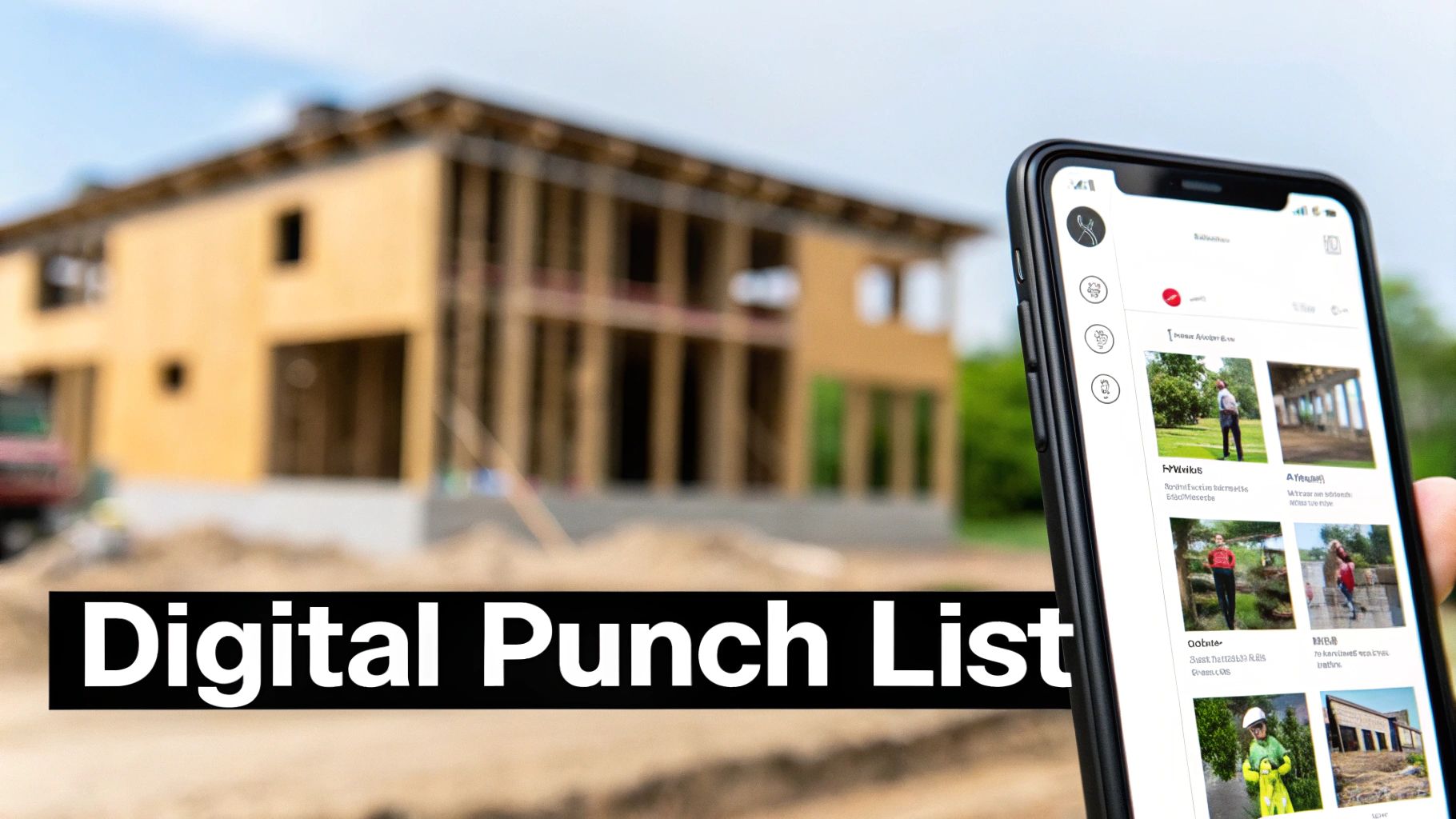
The old-school approach created frustrating delays. A note about a leaky faucet had to be carried back to the trailer, maybe typed up, and then finally handed off to the plumber. This slow-moving chain of communication could easily add days to a project schedule, turning the final stretch into a real grind.
The Digital Transformation of Punch Lists
Today, that trusty clipboard is finally being replaced by tablets and smartphones. Construction management software has turned the punch list from a static document into a living, breathing tool that everyone can interact with. Instead of scribbled notes, contractors can log detailed entries with a few quick taps on a screen.
It’s not just about going paperless. These modern tools offer a completely different way of working:
- Real-Time Collaboration: The owner, architect, and every subcontractor can see and update the list instantly, no matter where they are.
- Photo and Video Evidence: You can snap a photo or take a quick video of an issue and attach it directly to the punch list item. No more confusion about which scuff or which fixture needs attention.
- Direct Task Assignment: A task can be assigned straight to the responsible subcontractor, who gets an automatic notification. This creates clear ownership and accountability.
- Clear Progress Tracking: Digital dashboards give you a bird's-eye view of what’s done, what’s left, and which teams are hitting their deadlines.
The term ‘punch list’ comes from the physical act of punching a hole in the paper next to a completed task. It’s a bit of a throwback, but today’s digital systems have cut punch list mistakes by as much as 60% and project closeout times by an estimated 40%. You can learn more about the evolution of punch list management.
This move to digital isn't just a minor upgrade; it's a fundamental change that improves accuracy, speeds up communication, and creates a transparent audit trail for the entire closeout process. What used to be a major project bottleneck is now a much smoother workflow that helps everyone get to the finish line—and get paid—sooner.
The difference between the old way and the new is night and day. Let's break it down.
Paper Punch Lists vs. Digital Punch Lists
| Feature | Paper Punch List | Digital Punch List |
|---|---|---|
| Updates | Manual; updates happen only when someone physically shares the paper. | Instant and in real-time for all users. |
| Clarity | Relies on handwritten notes, often leading to misinterpretation. | Uses photos, videos, and typed text for crystal-clear instructions. |
| Communication | Slow and manual; requires phone calls, emails, or in-person meetings. | Automated notifications and direct assignments to the right people. |
| Tracking | Difficult to track progress; relies on memory or separate logs. | Centralized dashboard shows the status of every single item. |
| Accessibility | Limited to whoever holds the physical clipboard or a copy. | Accessible 24/7 from any device (phone, tablet, computer). |
| Accountability | Can be ambiguous; "he said, she said" situations are common. | Creates a clear, time-stamped record of who is responsible for what. |
| Reporting | A manual, time-consuming process to compile reports. | Generates detailed progress reports with a single click. |
While paper and pen got the job done for decades, the advantages of modern tools are impossible to ignore. They simply offer a more efficient, accurate, and collaborative way to manage the crucial final phase of a construction project.
Best Practices for a Flawless Punch List Process
A punch list gone wrong can quickly spiral from a simple to-do list into a mess of costly delays and angry clients. The goal isn't just to get through it; it's to turn this final step into a powerful quality control tool that leaves everyone satisfied. With a few key strategies, you can make sure your project closeout is smooth, professional, and efficient every single time.
One of the best things you can do is adopt a rolling punch list. Don't wait until the final walkthrough to start pointing out issues. Instead, tackle them as they pop up during construction. This proactive approach keeps a massive, overwhelming list from building up at the end. It turns the final phase from a frantic scramble into a simple process of tidying up a few loose ends.
Be Specific and Document Everything
Vagueness is the enemy of an efficient punch list. A fuzzy description just creates confusion, leads to rework, and wastes everyone's time. Every single item you log needs to be crystal clear and actionable.
- Bad Example: "Fix wall in master bedroom."
- Good Example: "Repair 3-inch drywall scuff on the north wall of the master bedroom, located 2 feet to the right of the window. Repaint to match existing color."
Backing up every entry with clear photos or a quick video is no longer a "nice-to-have"—it's a must. A picture instantly erases any doubt and gives the subcontractor a visual guide, so they show up with the right tools and materials to get the job done right the first time.
A punch list should tell a clear story. Each entry needs a specific location, a detailed description of the problem, and visual proof to leave zero room for error. This level of detail is fundamental to accountability and swift resolution.
Establish Clear Workflows and Deadlines
A list without a plan is just wishful thinking. You need to set up a clear process for how items get reported, who they're assigned to, and how they’re signed off on. Just as important is setting deadlines that are realistic but firm. This creates a healthy sense of urgency and keeps the project from stalling without burning out your trade partners. This structured approach is a key part of any good construction quality control checklist, making sure high standards are always the priority.
Digital tools have completely changed the game here. In a recent survey, 70% of construction professionals said that well-documented punch lists dramatically cut down on disputes. Another 65% noted that digital platforms made the whole process feel much more collaborative. As the industry moves forward, these lists are becoming powerful, data-driven tools that don't just fix problems—they improve project quality and boost client satisfaction. You can discover more insights about the global impact of punch lists. By pairing clear communication with the right tech, you can deliver a flawless handover every time.
Common Questions About Construction Punch Lists
Even with a solid plan, a few questions always seem to pop up as a project nears the finish line. You understand the basic concept of a punch list, but the real-world details can get a little fuzzy. Let’s clear up some of the most common questions that arise.
Who Is Responsible for Creating the Punch List?
While it’s a team effort, the general contractor ultimately owns the punch list. They are the ones responsible for pulling it all together and managing it.
Typically, the contractor does a preliminary walkthrough on their own to create a starting draft. Then, during the formal inspection, the owner and architect add their items to the list, creating the final version everyone works from.
Can a Homeowner Add Items to the List?
Absolutely. In fact, a homeowner's input is crucial—they're the ones who will live in the space!
During the final walkthrough, homeowners should feel empowered to point out anything that doesn't meet their expectations. Your final sign-off is what closes out the project, so your active participation is non-negotiable.
What Happens if a Subcontractor Refuses to Fix an Item?
It happens. If a subcontractor disputes an item, the general contractor steps in to play mediator. They’ll pull out the original contract and compare the specs to the work in question.
If the work truly doesn't meet the standard, the subcontractor is contractually obligated to fix it. If they still refuse, the contractor can hire someone else to do the work and deduct the cost from the subcontractor's final payment.
A punch list isn’t just a friendly to-do list. It's a contractual tool that formally documents the remaining work required to fulfill the agreement. Final payment and project acceptance hang on its completion.
Is There a Deadline for Completing Punch List Items?
Yes, there should always be a deadline. A good punch list includes firm—but fair—deadlines for each task.
The general contractor sets these timelines to keep everything moving forward efficiently. Without them, it's easy for the project to drag on, so these dates are critical for getting everyone coordinated and across the finish line.
At CJMC Build, we believe a transparent and meticulous punch list process is the key to a successful project handover. If you're ready to build a custom home in the Nashville area with a team dedicated to quality down to the last detail, let's start the conversation. Learn more about our building process.

