


So, what exactly is a general contractor? In simple terms, a GC is the single point of responsibility for making sure a construction project gets done right, from the first shovel in the ground to the final coat of paint.
Think of them as the conductor of an orchestra. You have dozens of skilled musicians—the plumbers, electricians, framers, and roofers—but without a conductor to lead them, you'd just have noise. The general contractor is the one who makes sure everyone plays their part at the right time to create a beautiful symphony: your finished home.
Understanding the Role of a General Contractor
When you set out to build a custom home in Middle Tennessee, you're doing more than just hiring someone to swing a hammer. You’re bringing on a professional project manager whose entire job is to transform a stack of blueprints into a real, livable space.
Your GC is your main contact and your biggest advocate throughout the entire process. They’re the ones orchestrating all the moving parts to keep your build on schedule and on budget.
The Project's Central Hub
At its core, a general contractor acts as the primary manager for the entire build. They're in charge of overseeing everything from start to finish—hiring the right crews, making sure everything is up to code, pulling permits, ordering materials, and keeping a close eye on the timeline and budget. You can find more insights on the state of the modern construction industry on Deloitte.com.
This central point of command is what saves you from the nightmare of trying to hire, schedule, and pay dozens of different specialists yourself. With a GC, it's all handled.
A great general contractor doesn't just build a house; they build a cohesive team, a predictable schedule, and a reliable budget. They are the expert who navigates the complexities of construction so you don't have to.
To give you a clearer picture, here’s a quick rundown of what a general contractor brings to the table.
General Contractor At a Glance
| Key Responsibility | What This Means for Your Project |
|---|---|
| Full Project Oversight | They manage the day-to-day operations on-site, ensuring everything runs smoothly. |
| Subcontractor Management | They vet, hire, and coordinate all the specialized trades (plumbers, electricians, etc.). |
| Budget & Schedule Control | They create the master plan for time and money and work to keep the project on track. |
| Permitting & Inspections | They handle all the red tape with local authorities to ensure your home is fully compliant. |
| Quality & Safety Assurance | They enforce high standards for craftsmanship and maintain a safe working environment for everyone. |
Essentially, the GC is the glue that holds the entire project together, ensuring a high-quality outcome.
Core Responsibilities
When you boil it down, a general contractor’s job is to masterfully balance three key things: time, budget, and quality. Their duties are wide-ranging and touch every single phase of the build.
Here are some of the most critical tasks they handle:
- Hiring and Managing Subcontractors: A good GC has a deep network of trusted and proven tradespeople. They know who to call for top-notch electrical, plumbing, framing, and finishing work.
- Creating and Sticking to a Schedule: They lay out a detailed project timeline, coordinating every step to sidestep costly delays and keep things moving forward efficiently.
- Overseeing the Budget: From the initial quote to the final invoice, the GC meticulously tracks every dollar spent to keep your project from going over budget.
- Ensuring Quality and Safety: They are ultimately responsible for job site safety and for making sure every aspect of the build meets strict quality standards and local building codes.
In the end, your general contractor is the leader tasked with one mission: delivering your dream home, exactly as you imagined it.
What Does a General Contractor Actually Do All Day?
So, what’s a day in the life of a general contractor really look like? Forget a simple nine-to-five desk job. It's a masterclass in juggling logistics, managing people, and putting out fires before they even start. Every single day is about pushing a massive, complex project one step closer to the finish line.
A GC’s morning often starts before the sun comes up, walking the job site with a cup of coffee in hand. They're checking the progress from the day before, making sure everything is secure, and mentally mapping out the critical path for the hours ahead. Then, the phone starts ringing. They're coordinating with the foundation crew, confirming the lumber delivery, and making sure the plumber knows exactly when to show up. These calls set the rhythm for the entire day.
The Conductor of a Construction Orchestra
At its heart, a general contractor’s job is about coordination and logistics. Think of them as the conductor of an orchestra. They don't just hire musicians (subcontractors); they meticulously manage when each one plays their part to create a beautiful symphony. You can't have the drywall hangers show up before the electrician has run all the wiring—it just doesn't work. A great GC ensures that flow is seamless.
They’re also the masters of “just-in-time” delivery. If lumber arrives too early, a classic Middle Tennessee thunderstorm could warp the whole stack. If it arrives too late, the framing crew is standing around with nothing to do. It’s a logistical puzzle that requires incredible foresight and solid relationships with local suppliers.
- Subcontractor Scheduling: This means lining up the schedules of dozens of specialized crews—plumbers, electricians, roofers, painters—to avoid costly downtime and keep the project moving.
- Material Procurement: They're responsible for ordering everything from concrete and rebar to the specific hinges for your kitchen cabinets, ensuring it all arrives on schedule and meets the quality standards you expect.
- Permit and Inspection Management: A huge part of the job is dealing with local city and county officials to schedule mandatory inspections at just the right time. This requires precision, paperwork, and a deep understanding of local building codes.
This intense, behind-the-scenes coordination is where a GC earns their keep. They take on all the logistical headaches so you don't have to.
Your Professional Problem-Solver
Let's be honest: no custom home build goes exactly as planned. Surprises are part of the process. A sudden downpour might flood an open foundation, or a supplier might call to say those custom windows you love are on backorder. This is when a general contractor shifts from planner to problem-solver.
Their entire job is to handle these curveballs without derailing the schedule or blowing up the budget. They’re the ones renting pumps to clear out the water, calling their network of suppliers to find an alternative for the backordered material, or reshuffling the schedule to keep other crews busy while one part of the project is on pause.
A skilled general contractor anticipates potential problems, but more importantly, has the experience and resources to react decisively when the unexpected happens. Their ability to adapt is what separates a smooth build from a stressful, chaotic one.
The scale of what they manage is enormous. In the U.S., the construction industry's revenue is on track to hit a staggering $3.7 trillion by 2025, and GCs are the ones steering these massive projects. They're handling the contracts, the insurance, and all the compliance paperwork that makes a build successful and legal. If you're curious, you can explore more construction industry statistics to see the full economic scope.
When it comes down to it, a day in the life of a GC is all about communication. They are the central hub, constantly talking to subcontractors, suppliers, building inspectors, and—most importantly—to you, the homeowner. This constant, open line of communication keeps everyone on the same page and ensures your vision is being brought to life, one carefully managed day at a time.
How GCs Turn Blueprints Into Your Home
An architect’s blueprints are the soul of your future home—a detailed, technical map of a dream. But how do those lines on paper become the wood, steel, and stone you’ll eventually live in? That magic happens because of a general contractor, who guides the project through three distinct phases.
This isn't a random process. It’s a carefully choreographed performance. A good GC ensures every step, from clearing the land to the final coat of paint, is executed with skill, quality, and a deep respect for the original vision.
The Pre-Construction Foundation
Long before a single shovel hits the dirt, your general contractor is already putting in the hours. This is the pre-construction phase, and it’s all about setting the project up for success. Your GC will sit down with you and the architect to really dig into the plans.
They’ll review every detail, offering practical advice on how things will actually be built, suggesting better materials, and finding ways you might be able to save some money. This is also when they put together detailed and realistic cost estimates, so you know exactly what you’re getting into financially. If you want to get a better handle on these documents yourself, check out our guide on how to read architectural blueprints.
Getting this phase right is absolutely critical. A thorough pre-construction process heads off expensive changes and frustrating delays later on, paving the way for a much smoother build.
On-Site Execution and Management
With the plans locked in and permits in hand, the action moves to the job site. This is where the abstract ideas start to become real, and your GC’s hands-on leadership is non-negotiable.
The build-out follows a proven, logical order:
- Groundbreaking and Foundation: First, the site is cleared, excavated, and graded. Then comes the concrete foundation—the literal bedrock of your home—which has to be poured with absolute precision.
- Framing and Structure: Next, the skeleton of the house goes up. You'll see walls framed, floors laid, and the roof structure assembled, finally giving shape to the rooms you've imagined.
- Exterior and Interior Rough-Ins: Once the frame is up, the home gets "dried in" with roofing, siding, and windows. At the same time, an army of subcontractors is inside, running all the plumbing, electrical wiring, and HVAC ductwork through the walls.
- Finishes and Details: This is the fun part, where the house’s personality really shines through. Drywall is hung, flooring goes down, cabinets are installed, and fixtures are put in place, bringing your interior design to life.
Through all of this, the GC is the conductor of the orchestra, making sure every trade does its part perfectly, solving problems as they arise, and maintaining a high standard of quality.
This infographic breaks down what a typical day looks like for a GC, juggling what’s happening on-site with the necessary office work and client communication.
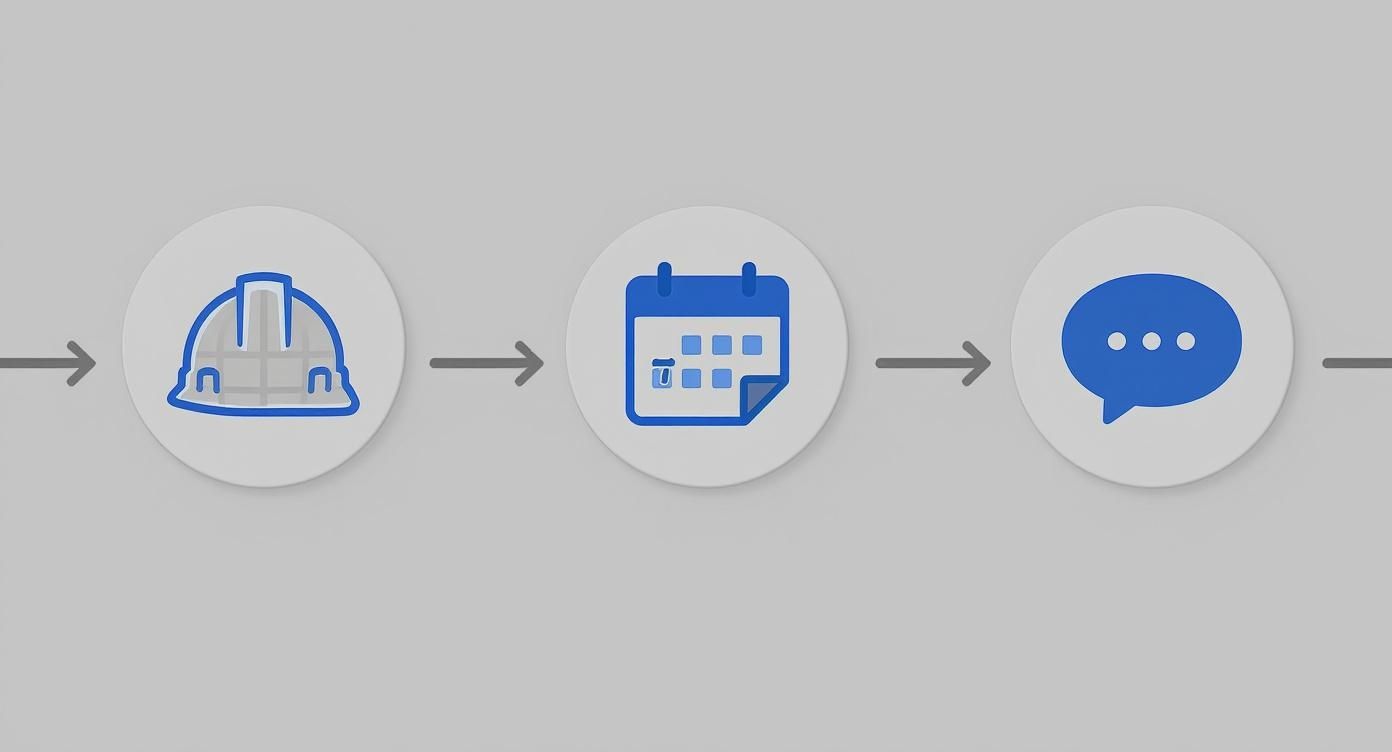
As you can see, a contractor's day is a constant mix of hands-on site supervision, critical back-office planning, and keeping you in the loop.
Post-Construction and Handover
As the dust settles and the final touches are made, the project moves into the post-construction phase. This is the last hurdle before you can officially call the house your home.
The final walkthrough isn’t just a formality; it’s the GC’s commitment to delivering perfection. It’s the moment where a construction project officially becomes a homeowner’s dream realized.
During this walkthrough, you and your GC will go over every inch of the home. You’ll work together to create a "punch list," which is simply a list of any small things that need tweaking—a paint touch-up here, a sticky cabinet door there. Your GC is responsible for making sure every single item on that list is taken care of.
Once you’re completely satisfied, all inspections are passed, and every detail is just right, your general contractor hands you the keys. It’s the rewarding end to months of planning and hard work—the moment a blueprint finally becomes your beautiful new home.
The True Value of Hiring a General Contractor
https://www.youtube.com/embed/Hg809By68Ks
When you see a general contractor’s fee on a project estimate, it’s natural to think, “Could I save a chunk of money by just running this project myself?” It's a fair question, but it often overlooks the real, tangible value a great GC brings to the table. Think of them less as a cost and more as an investment—one that pays dividends in efficiency, cost savings, and your own peace of mind.
Trying to manage a custom home build on your own is, quite literally, a full-time job. You’d be spending your days (and nights) vetting dozens of subcontractors, chasing down material orders, and trying to decipher complex local permitting laws. A general contractor absorbs all of that for you, freeing you from the relentless daily grind and logistical nightmares that come with a major construction project.
An Investment in Savings and Sanity
Beyond just saving you time, a good general contractor almost always saves you a surprising amount of money. How? GCs have spent years building solid relationships with local suppliers and trade partners. These long-term connections give them access to professional-grade discounts on materials and labor that the general public simply can't get.
Often, these savings alone can offset a significant portion of the contractor's management fee. Even more importantly, their expertise acts as a powerful defense against the expensive mistakes that so often derail self-managed projects—like ordering the wrong type of lumber or failing a critical plumbing inspection. A GC’s job is to get things done right the first time, protecting your budget from the crippling cost of rework.
A general contractor isn't just another line item in your budget. They are your chief financial officer, risk manager, and quality control expert, all rolled into one. They protect your investment by ensuring every dollar is spent wisely and effectively.
To really see what’s at stake, it helps to put the two approaches side-by-side.
DIY Project Management vs Hiring a General Contractor
| Project Aspect | Managing It Yourself (DIY) | With a General Contractor |
|---|---|---|
| Time Commitment | A full-time job managing calls, schedules, and site visits. | Frees you to focus on your life and make key decisions. |
| Material Costs | Pay full retail prices for all materials and supplies. | Access to trade discounts, saving you thousands. |
| Liability & Insurance | You are fully liable for all accidents and property damage. | Fully licensed and insured, protecting you from risk. |
| Problem Solving | You must solve every unexpected issue on your own. | Expertly handles delays and problems to keep work on track. |
As you can see, the DIY route comes with a heavy burden of responsibility and financial risk that many people don't anticipate. A general contractor is specifically equipped to handle these pressures, turning a potentially chaotic process into a structured, professionally managed build.
The Ultimate Safety Net
Finally, one of the most critical—and often overlooked—roles a GC plays is shielding you from liability. Professional contractors are required to carry comprehensive insurance policies, including general liability and workers' compensation. This is your financial armor. If an accident happens on your property, their insurance covers it, not yours.
They are also legally responsible for making sure the entire project complies with local building codes and safety regulations. This know-how is essential for passing inspections and avoiding fines or legal headaches down the road. The foundation for all this protection is a clear, thorough contract. Understanding what goes into a residential construction contract template is a crucial step for any homeowner, as it documents everyone’s responsibilities and provides a legal framework that safeguards your project from beginning to end.
How to Hire the Right General Contractor

Let's be honest: choosing your general contractor is probably the single most important decision you'll make for your custom home. This is the person who will be your partner for months, turning a set of plans into your family’s future home.
The right GC will be your trusted advocate, making the entire process feel manageable and even exciting. The wrong one? Well, that can quickly turn a dream project into a nightmare of delays, budget overruns, and constant stress. So, how do you find the right one? It all comes down to a bit of thoughtful, structured research.
Finding Reputable Candidates
The first step is simply building a list of potential builders. Forget casting a wide net with a generic internet search. You want to start with sources that already have a layer of trust built-in.
Here are the best places to look for a great GC in Middle Tennessee:
- Architect and Designer Referrals: Your architect has been in the trenches and knows which builders can deliver. They’ve seen firsthand who executes plans precisely and who cuts corners. Their recommendation is pure gold.
- Local Builder Associations: Groups like the Home Builders Association of Middle Tennessee (HBAMT) are a great resource. Their members are typically vetted and have to uphold certain professional standards.
- Word-of-Mouth: Nothing beats a glowing review from a friend or family member who has gone through the process. Ask around—a personal recommendation is often the most reliable sign of quality you can get.
Aim for a shortlist of three to five contractors. From there, the real vetting process begins.
Key Questions to Ask in an Interview
Think of this as more than just an interview; it's a conversation to see if your personalities and expectations align. You need to get a feel for their process, communication style, and how they run their business. A true professional will welcome your questions.
Make sure you cover these crucial points:
- Licensing and Insurance: This is non-negotiable. Ask for their state license number and proof of both general liability and workers' compensation insurance. This protects you.
- Experience with Similar Projects: Have they built homes like yours before—in terms of style, size, and budget? Ask to see specific examples.
- Communication Process: How will you stay in the loop? Will you get weekly updates? Who is your main point of contact? A clear plan for communication is absolutely essential.
- Subcontractor Relationships: Do they have a go-to team of plumbers, electricians, and framers they trust? Long-term relationships with subcontractors usually mean higher-quality work and more reliable schedules.
Your general contractor is more than just a builder; they are your project partner. The goal of the interview is to find someone with not only the right skills and experience but also a communication style that gives you confidence and peace of mind.
Verifying and Finalizing Your Choice
Once you've finished the interviews, you're on the home stretch. But don't skip these last two critical steps: checking references and reviewing the contract.
Call at least two or three of their past clients. Ask them the tough questions: Was the project on time? Did they stick to the budget? How did they handle problems when they came up?
Finally, ask for a detailed, itemized contract. It should spell out the entire scope of work, include a payment schedule based on project milestones, and provide a clear timeline. For a deeper dive, our guide on how to choose a contractor walks you through everything to look for. A thorough, transparent contract is the bedrock of a great partnership.
Common Questions About General Contractors
Even with a good grasp of what a general contractor does, you probably still have a few questions rolling around in your head. That’s completely normal. Getting clear, straightforward answers is the best way to feel confident about moving forward with your custom home build.
The construction world can seem a bit mysterious from the outside, but it doesn't have to be. Let's tackle some of the most common questions people ask to clear up any confusion before you even think about breaking ground.
General Contractor vs. Subcontractor
So, what’s the real difference between a general contractor and a subcontractor? This is a classic question, and the answer comes down to hierarchy and who's responsible for what.
I like to use a team analogy: the general contractor is the head coach of your project. You hire them directly to see the big picture and execute the entire game plan. They, in turn, bring in the subcontractors, who are the specialist players—the electricians, plumbers, painters, and roofers. Each one is an expert in their position, but it's the GC's job to coordinate their efforts so they work together seamlessly. Your contract is with the GC; their contracts are with the subs.
How General Contractors Get Paid
Payment structures can differ from one project to the next, but they should always be spelled out clearly in your contract before a single nail is hammered. This kind of transparency is the foundation of a good relationship with your builder.
Typically, you'll see one of two payment models:
- Fixed Price: This is exactly what it sounds like. You and the contractor agree on a total cost for the entire project upfront. That price is set in stone unless you make official changes to the original plan.
- Cost-Plus: With this model, you agree to pay for the actual costs of all labor and materials, plus a pre-negotiated fee or percentage that covers the general contractor's management and overhead. It offers more flexibility, but the final price tag isn't as certain from day one.
No matter the model, you'll almost always pay in stages, often called "draws." These payments are tied to hitting specific milestones, like pouring the foundation or completing the framing.
Understanding your payment structure is crucial. It’s not just about knowing the total cost; it’s about having a clear roadmap for how and when funds will be disbursed throughout the life of the project.
When a General Contractor Is Necessary
Do you really need a GC for a small renovation? Honestly, it depends entirely on the complexity of the job.
If you're tackling a simple, single-trade task like painting a bedroom or swapping out a kitchen faucet, you can absolutely hire a painter or plumber directly. But the second your project involves multiple trades that need to be coordinated, a general contractor becomes your most valuable asset.
Think about a kitchen remodel. You've got demolition, plumbing, electrical, cabinet installation, countertop fabrication, tiling, and painting. A GC is the person who orchestrates that complicated dance, making sure everyone shows up at the right time and that all the work meets local building codes. Without one, you’re stuck being the project manager—a full-time job that can get overwhelming fast.
Ready to build your dream home with a team that values transparency and craftsmanship? CJMC Build is a trusted Nashville-based general contractor dedicated to bringing your vision to life. Let's start the conversation about your project today. Learn more and schedule your free consultation at cjmcbuild.com.

