


Financing a new home build isn't like buying a house that's already standing. It's a completely different animal. You’ll be working with a short-term construction loan that pays your builder in phases as they get the work done. Once your home is finished and you have the certificate of occupancy, that initial loan gets either converted into or replaced by a permanent, long-term mortgage.
Understanding this two-step process is the key to getting started.
Understanding New Home Construction Financing
Building from the ground up is an incredible experience, but the financial side of things can be tricky. Instead of a single, one-and-done payment at closing, you're managing a series of payments—called draws—that go to your builder as they hit specific construction milestones. This protects everyone involved; the bank isn't just handing over a huge pile of cash, and you know the money is only being released as real progress is made.
The financial climate for building a new home has definitely gotten tougher recently. Rising interest rates and stricter lending standards have made financing more expensive and a bit more complicated. I've seen banks ask for higher equity contributions from borrowers, which unfortunately puts some projects on hold.
The Basic Financing Roadmap
Before you dive in, it helps to know the lay of the land. Here's a high-level look at the journey ahead, which helps set the right expectations from day one.
- Nailing Down Your Budget: This is ground zero. You need a rock-solid understanding of your total project cost—land, materials, labor, permits, and a healthy contingency fund. You absolutely have to do this before you even think about talking to a lender.
- Getting the Construction Loan: This is where you apply for the specialized loan to cover the build itself. Lenders will put your builder, your architectural plans, and your own finances under a microscope.
- Managing the Draw Process: As construction moves along, funds are released in chunks according to a "draw schedule" you agree on upfront. An inspector usually has to sign off on the completed work before the bank releases the next payment.
- Converting to a Permanent Mortgage: Once the final nail is hammered, the temporary loan is closed out. Your loan will either automatically roll into a standard mortgage (a one-time close) or you'll refinance it into one (a two-time close).
This visual lays out the core phases of the financing journey, from initial budgeting to the final build.
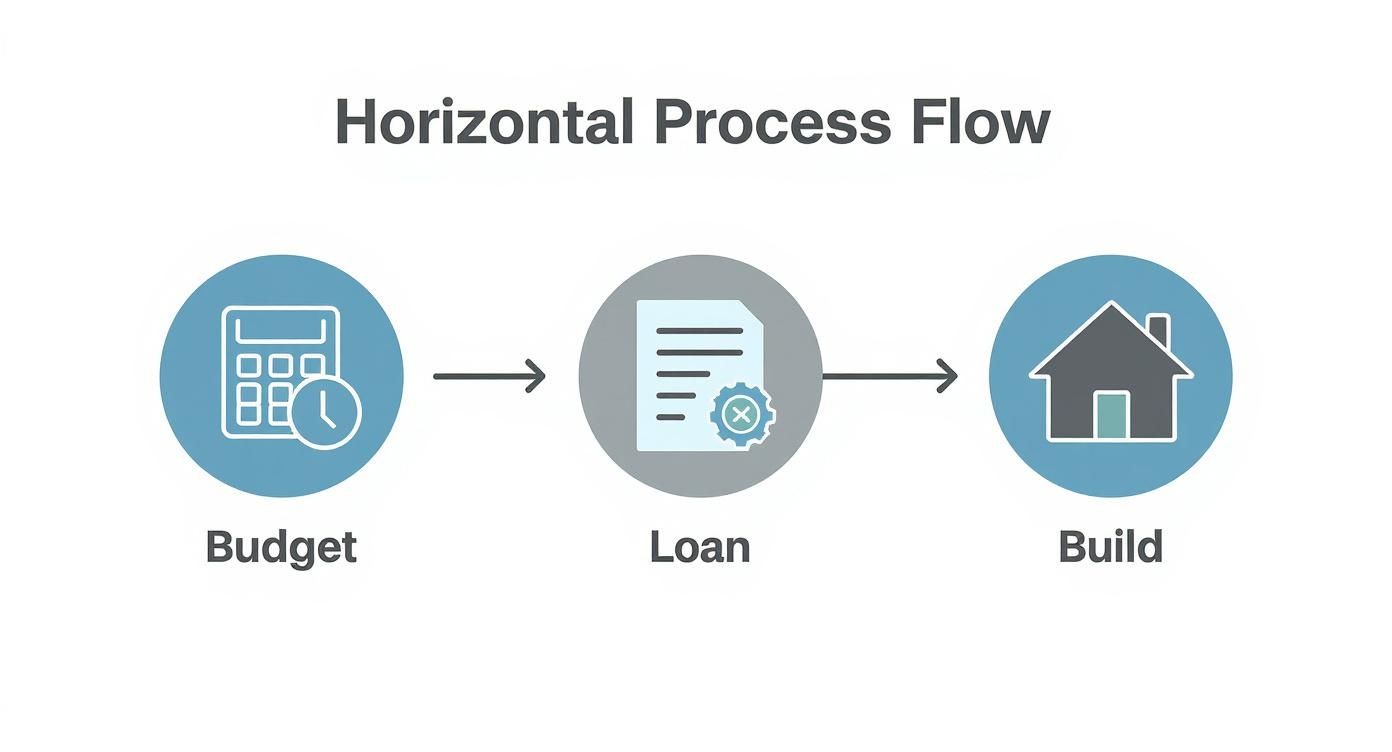
As you can see, each step builds on the last. It really drives home the point that a successful build starts with a solid financial plan.
Before we dive deeper, here’s a quick-glance table to help you get familiar with the core concepts. Think of it as your cheat sheet for the key terms and ideas you'll encounter.
Construction Financing At a Glance
| Financing Concept | What It Means For You |
|---|---|
| Construction Loan | A short-term, interest-only loan that covers the cost of building your home. |
| Permanent Mortgage | The long-term, traditional home loan you'll have after the house is built. |
| Draw Schedule | A pre-approved payment plan that releases funds to your builder at key construction milestones. |
| Contingency Fund | An extra cash reserve (usually 10-20% of the budget) set aside for unexpected costs. It's non-negotiable. |
| One-Time Close | A single loan that combines the construction and mortgage financing, converting automatically. Simpler, but less flexible. |
| Two-Time Close | Two separate loans: one for construction, followed by a second for the permanent mortgage. More paperwork, but you can shop for better rates. |
Grasping these ideas upfront will make the entire process feel much more manageable.
Key Takeaway: Think of financing a new build not as a single transaction, but as a managed project. Your loan isn't just a lump sum of cash; it's an active financial tool you'll use throughout the construction process.
Deciding to build is a massive financial commitment, and it's smart to weigh the pros and cons. For a detailed breakdown, take a look at our guide on the cost of buying vs. building a home to help you feel confident in your choice. At the end of the day, a solid understanding of this unique financing path is the first real step toward bringing your custom home to life.
Choosing the Right Construction Loan for Your Build
When you start digging into financing a new home, you'll quickly discover there’s no single, perfect loan for every project. The right choice for you really comes down to your long-term plans, your current financial picture, and even how much paperwork you're willing to tackle.
Making a poor choice here can inject a lot of unnecessary stress and cost into your build. On the other hand, the right loan can smooth the entire path from breaking ground to finally getting your keys. The decision you make at this stage really does set the tone for the entire journey.
The All-in-One Solution: Construction-to-Permanent Loans
For most people building a home they plan to live in for years, the Construction-to-Permanent (C2P) loan is the go-to option. It's often called a "one-time close" loan because it's exactly that—a single financial package that covers both the build and the final mortgage.
You'll only have to go through the full underwriting and closing process once, right at the start.
During the actual construction, you make interest-only payments on the money the bank has paid out to your builder. Once the home is finished and the final inspections are cleared, the loan seamlessly rolls over into a standard mortgage with regular principal and interest payments.
The big draw here is the simplicity and peace of mind. You lock in your mortgage interest rate before a single shovel hits the dirt, which is a huge relief when a build can easily take 6 to 12 months. It protects you from the risk of rates climbing while you're focused on construction.
Real-World Scenario: Let's say the Miller family is building their dream home in Williamson County. A C2P loan is perfect for them. They want to lock in an interest rate now and not have to worry about re-qualifying for a mortgage a year down the road when rates or their own financial situation might have changed. They get all the heavy lifting done upfront, so they can focus on the build itself.
The Flexible Approach: Standalone Construction Loans
A standalone construction loan, also known as a "two-time close" loan, works completely differently. Think of it as a short-term, build-only loan. Its entire purpose is to fund the construction, and once the house is complete, you have to pay it back in full.
So, how do you pay it off? You secure a brand-new, traditional mortgage to replace it. This means you are essentially going through two separate loan processes, each with its own application, appraisal, and closing costs.
While it sounds like more work—and it is—this route offers a major advantage: flexibility. If your credit score jumps up during the build, or if mortgage rates happen to fall, you have the freedom to shop around for the absolute best mortgage deal on the market. This option is often popular with spec builders or savvy buyers who are confident they can land better terms later.
Government-Backed Construction Loan Options
Beyond the conventional loans from private banks, a few government-backed programs can open the door to financing a new build, especially if you don't have a massive down payment saved up.
FHA Construction Loans: Insured by the Federal Housing Administration, these are a favorite among first-time homebuyers. They allow for a down payment as low as 3.5%, and the credit score requirements are typically more forgiving than conventional loans.
VA Construction Loans: This is an incredible benefit for eligible veterans, active-duty service members, and surviving spouses. VA loans often require no down payment at all and don't come with private mortgage insurance (PMI), saving you a considerable amount of money over time.
USDA Construction Loans: If you're building in a qualified rural area, a USDA loan could be a game-changer. These loans are designed for low- to moderate-income borrowers and can also come with a no-down-payment option.
These government programs function like C2P loans, bundling the construction and permanent financing into one transaction, but they come with the added security and benefits of government backing.
To help you sort through it all, the table below breaks down the key differences.
Comparing Common Construction Loan Types
Deciding how to finance your new home is a big step. This in-depth comparison should help you weigh the primary options and see which one aligns best with your goals.
| Loan Type | Best For | Key Feature | Pros | Cons |
|---|---|---|---|---|
| Construction-to-Permanent | Homeowners building their "forever home" who value simplicity and predictability. | One closing process for both construction and permanent financing. | Lock in your rate upfront; fewer closing costs; less paperwork. | Less flexibility to shop for better mortgage rates later. |
| Standalone Construction | Spec builders or buyers confident in improving their financial standing or in a falling-rate market. | Two separate loans, one for building and one for the final mortgage. | Freedom to find the best mortgage rates upon completion. | Two sets of closing costs; risk of rates rising; must re-qualify. |
| FHA Construction | Buyers with lower credit scores or limited funds for a down payment. | Low down payment requirement, typically 3.5%. | More accessible qualification criteria; single closing process. | Requires FHA-approved builder; includes mortgage insurance. |
| VA Construction | Eligible veterans and service members who want to minimize upfront costs. | Often requires 0% down payment and no PMI. | Significant cost savings; backed by the Department of Veterans Affairs. | Must be an eligible veteran; requires a VA-approved builder. |
Ultimately, whether you prioritize predictability or flexibility will point you toward the right loan. Each path has its trade-offs, so consider what will help you sleep best at night during your build.
Getting Your Finances and Application Ready for a Lender
Before you ever sit down with a loan officer, the most crucial work happens at your own desk. Think of it this way: a successful construction loan application isn't just paperwork; it's a meticulously built case for your project. Lenders are taking a much bigger gamble on a home that’s still just a blueprint, so they’re going to put your finances under a microscope in a way they wouldn't for a standard mortgage.
Your goal is to present a package that screams competence and reliability. Getting this part right isn't just about getting a "yes"—it's about locking in the best possible rates and terms for your build.
Nailing Your Construction Budget
Your budget is the absolute cornerstone of your loan application. I can't stress this enough. Lenders need to see a realistic, line-by-line breakdown of every single cost. Handing them a vague or incomplete budget is the surest way to get a quick rejection.
This detailed budget, often called a "cost breakdown," has to cover everything. And I mean everything—not just the obvious stuff like lumber and labor. A budget that will pass muster with a lender needs to include:
- Land Costs: If you haven't bought the lot yet, this means the purchase price, all the closing costs, and any surveys you'll need.
- Permits and Fees: This bucket includes building permits, impact fees, utility connection fees, and any other city or county charges. These can sneak up on you and easily run into the tens of thousands.
- Design and Engineering: The fees you pay your architect and engineer for creating the professional plans for your home.
- Hard Costs: This is the meat of your budget—all the physical materials (from the concrete for the foundation to the shingles on the roof) and the cost of every single subcontractor who will touch your project.
- Soft Costs: These are the essential, but less tangible, costs. Think construction insurance, project management fees, and the interest payments you'll make on the loan during the build.
And here’s the non-negotiable part: your budget must have a contingency fund of at least 10-20% of the total construction cost. This is your safety net for the inevitable surprises, like a sudden spike in material prices, unexpected site prep issues, or supply chain hiccups.
A Quick Word from Experience: Lenders don't see a healthy contingency fund as a sign that you're unsure about your numbers. Quite the opposite. It shows them you're a seasoned player who understands the realities of construction. It proves you have a plan to handle financial curveballs without derailing the entire project.
Putting Together Your Loan Application Package
Once your budget is rock-solid, it's time to assemble all the documents that will tell the complete story of your project. You're essentially building a portfolio to convince the bank that your build is a sound investment.
Here's the checklist of what you'll need to have ready to go:
- Detailed Plans and Specifications: This isn't just the blueprints. You'll also need a "spec book" that lists out every material choice, from the brand of the windows to the model of the faucets.
- A Signed Contract with a Reputable Builder: The bank will want to see your signed agreement with your general contractor. They'll also run their own checks on the builder’s license, insurance, and track record.
- The Comprehensive Cost Breakdown: That detailed budget we just talked about, signed by both you and your builder to show you're on the same page.
- Proof of Your Financials: This is the standard stuff—two years of tax returns, recent pay stubs, W-2s, and statements for your bank and investment accounts.
- Land Ownership Paperwork: If you already own the lot, you’ll need the deed or the original purchase agreement.
Showing up with this entire package organized and ready to go sends a powerful signal to the lender that you’re serious and professional, which can do wonders for speeding up the approval process.
Polishing Your Financial Profile Before You Apply
The details of your project are only half the story; your personal financial health is the other. Lenders are looking for borrowers who represent a low risk. Taking some time to strengthen your financial standing before you apply is one of the smartest things you can do.
You'll want to focus on two key numbers: your credit score and your debt-to-income ratio.
For your credit, most lenders want to see a minimum score of 680, but a score of 720 or higher is what really gets you into the territory of the best interest rates. If you're not quite there, spend a few months paying down credit card balances and making absolutely certain every single bill is paid on time.
At the same time, work on lowering your debt-to-income (DTI) ratio. That’s the percentage of your monthly gross income that goes toward paying off debts. If you can pay off a car loan or some personal debt before you apply, it can make a huge difference in the lender's calculations. A lower DTI proves you have the breathing room in your budget to comfortably take on the new construction loan payments, making you a much more appealing candidate.
Navigating the Loan Approval and Closing Process

Once you’ve submitted that hefty loan package, your part of the heavy lifting is done for a little while. The focus now shifts to the lender’s internal team. This is where the underwriters and appraisers take over, poring over every document to make sure both you and the project itself check all their boxes.
This waiting period can feel like an eternity, often taking anywhere from 30 to 60 days. It’s important to remember that the lender isn't just approving a borrower; they're becoming a financial partner for the entire build. Your best strategy here is patience, coupled with being ready to jump on any requests for more information.
Understanding the Construction Appraisal
One of the biggest differences between a construction loan and a standard mortgage is the appraisal. For an existing home, an appraiser looks at its current state and what similar houses have sold for. For a new build, they have to look into the future.
The appraiser’s goal is to determine the home's "as-completed" value. They'll comb through your architectural plans, material specs, and the builder's budget to project what the house will be worth when it's all said and done. This future value is the number your loan amount hinges on. It’s the bank’s way of ensuring the project is a solid investment from day one.
A Word of Caution: A low appraisal can throw a serious wrench in your plans. If the appraiser's number comes in below your total project cost, the lender will likely reduce the loan amount. This leaves you to cover the gap out of pocket. This is precisely why having a realistic, detailed budget and professional plans is so critical.
The broader housing market also has a huge impact on this valuation. For example, while the supply of new homes recently hit its highest point since 2007, construction trends are a mixed bag. Things like a slowdown in multi-family projects or softer housing demand can put a cap on price growth, which an appraiser has to consider. For a deeper look, J.P. Morgan offers a great breakdown of the current U.S. housing market outlook.
Finalizing the Draw Schedule
While the appraisal is in motion, another key document gets finalized: the draw schedule. Think of this as the payment plan for your builder. It’s a detailed timeline that links payments directly to specific, verifiable construction milestones.
Before you can close, you, your builder, and the lender all have to agree on and sign this schedule. It's the mechanism that protects everyone's financial interests as the project moves forward.
A simple draw schedule might include milestones like these:
- Draw 1: Foundation is poured and cured; framing is complete.
- Draw 2: The house is "dried in"—exterior sheathing, windows, and roofing are all installed.
- Draw 3: All rough-in work is done (plumbing, electrical, HVAC).
- Draw 4: Drywall is up and finished; exterior finishes are complete.
- Draw 5: Final inspections are passed, and the Certificate of Occupancy is issued.
This schedule is usually attached as part of the main construction agreement. Having a rock-solid contract is non-negotiable, and looking at a good residential construction contract template can show you exactly what to look for.
The Closing Process Explained
When the lender gives the final "clear to close," you’re in the home stretch. You'll schedule a closing meeting where you’ll sign what feels like a mountain of paperwork—the loan agreement, promissory note, and more.
This is also when you'll pay your closing costs, which for a construction loan typically run 3% to 5% of the total loan amount. These fees cover a variety of services:
- Origination fees
- Appraisal and inspection fees
- Title search and insurance
- Attorney fees
Once all the ink is dry, the deal is funded. The first draw is released to your builder, and with that, the administrative marathon is finally over. You can officially break ground.
Managing Your Loan During the Construction Phase
Getting your construction loan approved is a massive win, but it’s really just the starting line. Now the real work begins. You’re not just a future homeowner anymore; you’re an active manager of the financing that's bringing your vision to life. This phase is all about overseeing the flow of funds from the lender to your builder, and it all revolves around the draw schedule.
Unlike a standard mortgage where you get all the money at once, a construction loan pays out in stages. This system is designed to protect everyone—it ensures the lender’s money is being used as intended and gives you peace of mind that payments are tied directly to completed work.
How the Draw Process Works in Practice
Think of the draw process as the heartbeat of your construction financing. It's a transparent cycle designed to keep the project moving forward and hold everyone accountable.
So, how does it play out on the ground?
- First, your builder completes a major phase of work outlined in the schedule—let's say they've poured the foundation and finished the initial framing.
- Next, the builder submits a draw request to the lender. This triggers the lender to send an inspector to your job site to verify that the work is actually done and meets the required standards.
- Once the inspector signs off, the lender releases that chunk of money directly to your builder. This covers the costs for the work just completed and provides the funds to start the next phase.
This cycle repeats itself throughout the build, typically five to ten times, depending on the scale of your project. It's a methodical process that turns blueprints into a real home, one verified step at a time.
Navigating Common Construction Hurdles
Even the most carefully planned projects can hit a few bumps. Let’s be honest, issues like delays or budget overruns are more common than you might think. How you handle these challenges is what keeps your financing on solid ground.
Construction delays are a classic headache. They can be caused by anything from a week of bad weather to supply chain hiccups or a subcontractor’s scheduling conflict. To get ahead of this, it's crucial to understand your project’s critical path by reviewing a detailed new home construction timeline with your builder. That way, you can anticipate potential bottlenecks.
Budget overruns are the other big one. This is exactly why that contingency fund isn't just a nice-to-have; it's non-negotiable. If the cost of lumber suddenly spikes or an unexpected boulder field requires extra excavation work, that 10-20% fund is your first line of defense.
Key Takeaway: Open, honest, and frequent communication is your most powerful tool. The second a potential delay or cost issue pops up, you, your builder, and your lender need to be talking. Solving problems proactively is what stops small hiccups from turning into major financial headaches.
Where you build also plays a role. A geographic analysis from the National Association of Home Builders (NAHB) shows that single-family construction growth is highly concentrated in suburban areas of large cities, which now hold a 24.7% market share. This concentration can directly affect things like labor availability and material costs, introducing local variables you need to keep an eye on.
The Importance of Meticulous Record-Keeping
During the organized chaos of a build, it’s tempting to let paperwork slide. Don't make that mistake. Keeping meticulous records is one of the most important things you can do for a smooth project.
I recommend creating one central folder—digital or physical—for every single document related to your home. This includes:
- Signed Contracts: Your main agreement with the builder and any key subcontractors.
- Change Orders: Any modifications to the original plan, no matter how small, signed by both you and the builder.
- Draw Requests & Inspection Reports: The complete history of every payment milestone.
- Invoices & Receipts: Proof of payment for materials, labor, and everything in between.
This file becomes the official history of your project. It's your protection in case of a dispute, it helps you track your budget with pinpoint accuracy, and it provides a clean paper trail for the lender. Diligent record-keeping is what ensures a seamless transition when it's time to convert your construction loan into a permanent mortgage.
Common Questions About New Construction Financing
Jumping into construction financing can feel like learning a new language. You can have the big picture down, but it's the specific, nitty-gritty questions that tend to pop up and cause the most stress.
This is where we tackle the common "what-ifs" and practical details we hear about most often from our clients. Think of this as your quick-reference guide to help you build with confidence.
What Credit Score Is Needed for a Construction Loan?
Lenders are a bit more cautious with construction loans than they are with a standard mortgage on a finished house. After all, they're lending on a home that doesn't exist yet. Because of that, they're looking for a strong credit history.
Most lenders will set the bar at a minimum credit score of 680. But if you're aiming for the best interest rates and terms, you’ll want to be at 720 or higher. A solid score tells the lender you’re a reliable partner for a project that starts as just a set of plans. If your score isn't quite there, it's often worth taking a few months to boost it before applying.
How Much of a Down Payment Do I Need to Build a House?
This is another area where building a home differs from buying one. For a conventional construction loan, you should plan on a down payment of 20% to 25% of the total project cost. That figure includes the price of the land (if you're buying it) plus every dollar of the construction budget.
That can be a big number, but don't let it discourage you. There are fantastic government-backed programs that make building much more accessible:
- FHA Construction Loans: These can bring the down payment requirement down to as little as 3.5%.
- VA Construction Loans: For veterans and active-duty military, this is often a 0% down option.
These programs open the door for a lot of people who have great credit and income but haven't saved up a massive down payment.
Can I Get a Construction Loan if I Already Own the Land?
Yes, you can—and it’s a huge plus! If you own your land free and clear, you’re already way ahead of the game. Lenders see the equity you have in your land as a major asset, and you can often use it to cover your entire down payment.
It works like this: the lender appraises your land to see what it’s worth. That value then gets applied toward your down payment requirement.
Let's say your total project cost is $500,000, and the lender wants a 20% down payment ($100,000). If your land is appraised at $120,000, you’ve already covered the down payment and then some. This can seriously reduce the cash you need to bring to the table.
Key Insight: Using your land equity as a down payment is a smart, common strategy. It shows the lender you have serious skin in the game from day one, which always looks good.
What Happens if Construction Costs Go Over Budget?
This is the question that keeps a lot of future homeowners up at night. The good news is that lenders anticipate this, which is why a contingency fund is a mandatory part of any construction loan.
This fund is a financial cushion, typically 10% to 20% of your total construction budget, that's built right into your loan. When an unexpected cost pops up—a sudden jump in lumber prices or a tricky excavation issue—you pull from this reserve first.
If the overages are so big that they burn through the entire contingency fund, you will almost certainly have to cover the rest out of your own pocket. This is why a realistic, well-planned budget and a healthy contingency aren't just suggestions; they're essential for a smooth build.
Planning your dream home in Middle Tennessee? The team at CJMC Build brings decades of expertise to every custom new home construction project. Contact us today for a free quote and let's start building your vision.

