


Building your own home is one of the biggest, most personal projects you'll ever take on. Finding the right builder—someone who truly gets your vision and can bring it to life in the unique landscape of Middle Tennessee—is the single most important decision you'll make. It’s a journey that turns a big, often overwhelming, idea into an exciting, manageable reality.
Your Custom Home Journey in Middle Tennessee
This isn't just about construction. It's about creating a space that is a true reflection of your family, your lifestyle, and your future. Unlike buying an existing house, every single detail is up to you, from the way the foundation is poured to the hardware on your kitchen cabinets. That level of control is incredible, but it also means the builder you choose becomes a close partner for the better part of a year, or even longer.
A successful custom home build starts way before a single shovel of dirt is moved. It starts with a clear plan. Having that roadmap is your best defense against the classic pitfalls that can derail a project, like going way over budget or facing frustrating delays.
Understanding the Modern Custom Home Market
Even when the broader real estate market seems to cool off, the desire for truly personalized homes keeps the custom building sector strong. While rising interest rates might slow down the market for cookie-cutter spec homes, we've seen a consistent demand for unique, custom-built residences.
The numbers back this up. In the second quarter of 2025 alone, custom home building in the U.S. saw a 4% jump, with 54,000 new projects started. Over the entire last year, that number hit 184,000 homes, a 2% increase from the year before. It's clear that many families are prioritizing homes tailored specifically for them, often financing these projects with existing wealth rather than relying solely on traditional mortgages.
Custom-built homes now make up about 19% of all new single-family houses being built—the highest that number has been since 2022. It’s a powerful signal that buyers are choosing bespoke over boilerplate.
Charting Your Course in Middle Tennessee
Before you start searching for the "best custom home builders," you have to figure out what "best" really means for your project. It's about so much more than just flipping through beautiful online portfolios. It requires some honest self-reflection about your needs and a methodical way to vet potential builders.
That's what this guide is all about. We'll walk you through the entire process, covering the essentials:
- Doing Your Homework: How to build a solid shortlist of reputable builders in the area.
- Digging Deeper: Moving past the pretty pictures to verify credentials, talk to past clients, and see their quality firsthand.
- The Interview Process: Asking the tough questions that reveal a builder's communication style, transparency, and process.
- Making Sense of Bids & Contracts: What to look for in proposals and legal agreements to make sure you're protected.
Having a plan from day one is non-negotiable. For a really detailed, step-by-step guide, our new home construction checklist is an invaluable tool to keep you organized. With this foundation, you’ll be ready to find a builder who not only knows the ins and outs of building in Davidson, Williamson, and Rutherford counties but who is also the perfect partner for your dream home.
How to Find a Reputable Home Builder

Finding the right builder isn’t about getting lucky on Google. It's a strategic hunt for a true partner who gets your vision, respects your budget, and communicates the way you need them to.
The first move is to put together a solid short list. Don't cast the net too wide—aim for five to seven really promising candidates to start with. The key is finding professionals who know the ins and outs of building in Middle Tennessee, from our unique soil conditions to local zoning quirks and the best suppliers in the area.
Tap Into Local Expertise
Forget the generic national directories. Your search should start with the people who live and breathe Middle Tennessee real estate and construction. They have the firsthand knowledge you can’t find anywhere else.
A great place to begin is the Home Builders Association of Middle Tennessee (HBAMT). Membership here is a good sign. It tells you a builder is serious about their craft, connected in the community, and committed to professional standards. Their member directory is essentially a pre-vetted list to get you started.
New construction real estate agents are another goldmine of information. They see the finished product from countless builders and hear the real story from homeowners years after the work is done. They’ll know who hits their deadlines and who consistently goes over budget.
Look at Online Portfolios with a Critical Eye
Once you have a few names, it’s time for a deep dive into their work. A builder’s website is their digital handshake, and the portfolio is where they make their case. But don't just scroll through the pretty pictures.
Really dissect what you’re seeing. Do their projects have a consistent style that clicks with you? If you’re dreaming of a modern farmhouse, a builder who only showcases traditional brick colonials probably isn't the right fit, no matter how beautiful their work is.
You’re looking for evidence of true craftsmanship. Pay close attention to:
- Detailed Millwork: How do the trim, built-ins, and cabinetry look? Are the joints clean and tight? Is the design thoughtful or just an afterthought?
- Quality of Materials: Do the materials they feature—siding, roofing, flooring, fixtures—look and feel high-end and built to last?
- Architectural Harmony: Does the inside of the home make sense with the outside? A great builder creates a seamless, unified feel throughout the entire property.
A portfolio should give you a gut feeling about a builder’s quality standard and their design sensibilities. It’s your best tool for narrowing down the list to those who truly excite you.
A strong portfolio isn't just about showing off the biggest, most expensive homes. It’s about demonstrating a consistent ability to execute a clear vision with precision and artistry, no matter the square footage.
Gather Real-World Feedback
At some point, you have to move beyond the screen. Now it's time to find out how these builders work, not just what they've built.
Start with online reviews, but read them with a healthy dose of skepticism. You're looking for patterns. One bad review could be a fluke, but if you see multiple homeowners complaining about the same thing—like poor communication or constant budget surprises—that's a major red flag.
Don’t hesitate to do a little recon yourself. Drive by some of their past projects. You can usually find addresses or neighborhoods mentioned in their portfolio or on social media. Seeing a home in person, even just from the curb, tells you a lot about its presence and how the materials are holding up. Does it still look great a few years down the road? That's a powerful clue about the durability of their work.
The goal is to blend their polished online image with real-world evidence. As you hone your list, you might find it helpful to look for the best custom home builders near me to find even more location-specific feedback that’s directly relevant to your own project.
Vetting Builders Beyond Their Portfolios
A beautiful portfolio is the starting point, not the finish line. Let’s be honest, every serious builder has a gallery of stunning photos. But those glossy images won't tell you about their communication skills, how they manage a budget, or what happens when a crisis hits—like the wrong windows showing up on delivery day.
This is where you separate the true professionals from those who just take pretty pictures. It’s time for some serious due diligence. Your focus needs to shift to the three pillars of a trustworthy builder: their credentials, what past clients really think, and the quality you can see with your own eyes.
This infographic breaks down the essential flow for vetting any potential builder you're considering.
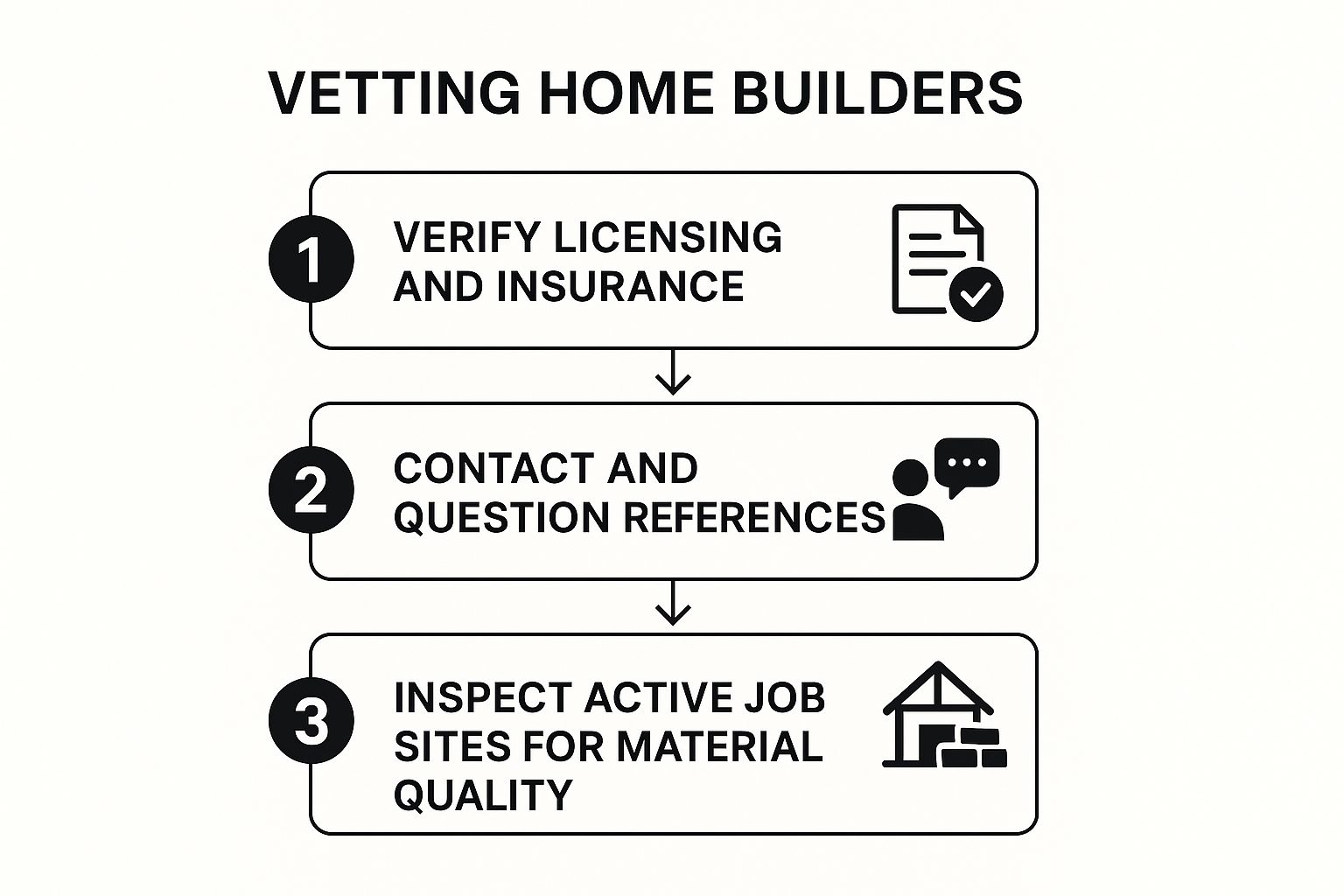
Following this sequence—verification, references, and then site visits—is crucial. It ensures you’re gathering hard facts before getting swayed by a polished sales pitch.
Verifying the Non-Negotiables
Before you invest another minute considering a builder, you have to confirm their legal and financial standing. This isn't just a formality; it's the single most important step to protect your investment. Any legitimate builder will have this information ready and will never hesitate to provide it.
You need to ask for proof of three key items:
- Licensing: In Tennessee, a contractor must be licensed for any project over $25,000. Don't just take their word for it. You can—and absolutely should—verify their license status directly with the Tennessee Department of Commerce and Insurance. An expired or nonexistent license is an immediate deal-breaker.
- Insurance: They need to carry both general liability and workers' compensation insurance. General liability covers damage to your property, while workers' comp is what protects you from a lawsuit if a worker gets injured on your land. Ask to see the actual insurance certificates and check that the coverage is current.
- Bonding: A surety bond is your safety net if the builder fails to complete the job or neglects to pay their subcontractors. While not always a legal requirement, the best custom home builders are bonded because it demonstrates financial stability and accountability.
A builder who is properly licensed, insured, and bonded isn't just following the rules. They're showing you they run a serious, professional business that's built to last—just like the home they'll build for you.
Asking References the Right Questions
Once their credentials check out, it's time to talk to people who have already been through the entire building process with them. Any builder can hand you a curated list of happy clients. Your job is to dig for the nuanced truth by asking specific, insightful questions that go way beyond, "Were you happy with your home?"
Instead of generic questions, get specific. Try these:
- "How did the builder handle unexpected issues or changes?" Problems are inevitable in a custom build. What you want to hear is that they were communicative, fair with change order costs, and focused on solutions instead of placing blame.
- "How did the final, all-in cost compare to the initial budget?" This question reveals their accuracy in estimating and their transparency about costs. Follow up by asking where and why the budget shifted.
- "What was their communication like during the project?" Were they proactive with updates? Was it easy to get the project manager on the phone? One of the most common complaints among homeowners is feeling left in the dark for weeks at a time.
- "Would you hire them again without a moment's hesitation?" The pause before someone answers this can be incredibly telling. It's a simple, direct question that cuts right through the noise.
Talking to past clients gives you a sneak peek into your own future experience. Listen carefully to how they answer, not just what they say.
Inspecting an Active Job Site
The final piece of the vetting puzzle is seeing their work in progress. A finished home is polished to perfection, but an active job site reveals the unvarnished truth about a builder's process, standards, and respect for their craft. Ask to visit a home currently under construction.
When you get there, here's what to look for:
- Cleanliness and Organization: A tidy, well-organized site is the hallmark of a professional crew that respects the project and prioritizes safety. Messy, chaotic sites often signal deeper organizational problems.
- Quality of Materials: Take a look at the lumber, windows, and other materials stacked on site. Do they look like high-quality products from reputable brands, or are they cutting corners? A builder's material choices speak volumes about their commitment to durability.
- Subcontractor Demeanor: Observe the crews at work. Do they seem professional, skilled, and engaged? The quality of a builder's subcontractors is a direct reflection of their own standards.
This level of scrutiny is absolutely essential. The U.S. residential construction industry is projected to hit $166.9 billion in 2025, but it's largely dominated by massive production builders. For instance, multi-family units made up 60% of home construction in 2023, and the top production builders completed over 90,000 homes in 2024 alone.
The best custom home builders operate in a different world entirely, focusing on a handful of highly specialized projects each year where this deep level of vetting truly matters. You can discover more insights about these market dynamics from IBISWorld's industry analysis.
To help you keep everything straight, here’s a quick checklist of the key criteria to review for each builder you’re seriously considering.
Builder Vetting Checklist Key Evaluation Criteria
A comparison of essential criteria to evaluate when vetting potential custom home builders, helping you systematically assess each candidate.
| Vetting Criteria | What to Look For | Why It Matters |
|---|---|---|
| Licensing | Active, valid Tennessee contractor's license for projects over $25k. | Protects you from unqualified or fraudulent operators. It's the law. |
| Insurance | Current certificates for General Liability & Workers' Compensation. | Shields you from liability for property damage or on-site injuries. |
| Bonding | Confirmation of a surety bond. | Provides financial protection if the builder defaults on the contract. |
| Client References | 3-5 recent clients; ask specific, in-depth questions. | Reveals their real-world performance in communication and problem-solving. |
| Job Site Visit | Cleanliness, material quality, and professional subcontractors. | Offers a transparent look at their daily standards and quality control. |
| Communication Style | Proactive updates, clear answers, and easy to reach. | A build is a long-term relationship; poor communication leads to stress. |
| Budget Transparency | Detailed estimates and a clear process for change orders. | Ensures you understand costs and avoids surprise expenses down the road. |
Using a consistent checklist like this for every builder on your shortlist makes it much easier to compare them objectively and make a confident, well-informed decision.
Asking the Right Questions in the Interview
https://www.youtube.com/embed/tUpknuv3z3c
You've done the research and narrowed your list down to a handful of builders who seem like a great fit. Now comes the most important part: the interview.
Think of this meeting as more than just a formality; it's a gut check. You aren't just hiring a company to build a house. You're choosing a partner for one of the biggest financial and emotional journeys of your life. The goal is to get past the glossy portfolio and see how they really operate.
You need to get a feel for their communication style, how they solve problems when things go sideways (and they always do), and their entire philosophy on working with clients. The answers you get here will tell you if their approach is genuinely a good match for what you expect over the next year or more.
Digging into Project Management and Communication
A beautiful home built on a foundation of stress, missed calls, and constant confusion is not a success story. The secret to a great building experience is a smooth, predictable process, and that all comes down to project management.
You need to know exactly how they keep everything on track and, just as importantly, how they'll keep you in the loop.
Get specific with your questions. Who is your day-to-day contact? Is it the owner, a dedicated project manager, or someone else? Knowing the chain of command from day one will save you a world of frustration when you have a question that needs a fast answer.
Here are a few essential questions to get that conversation started:
- How often can I expect to hear from you? Do we set up regular weekly calls? A builder who proactively schedules weekly check-ins is showing you they value communication.
- What tools do you use to manage the project? Many of the best builders today use platforms like CoConstruct or BuilderTrend to give clients a real-time dashboard with photos, updates, and financial documents. This kind of transparency is a huge plus.
- Walk me through your process for a change order. Listen carefully to this one. You’re looking for a clear, documented system, not a casual, "Oh, we'll just figure it out." A well-defined process shows they are organized and respect your budget and timeline.
A builder’s process is just as important as their final product. A team that prioritizes clear, consistent communication and transparent systems is one that respects your time and investment.
Clarifying Contracts and Financials
No two builders structure their contracts in exactly the same way. Generally, you’ll run into two main types: fixed-price and cost-plus. Understanding the nuts and bolts of each is absolutely critical for managing your budget.
A fixed-price contract is exactly what it sounds like—the total cost is locked in from the start. This provides a ton of certainty, which can be a huge relief. The trade-off is that it can be less flexible if you decide to make changes, and you can be sure the builder has priced in a contingency for things that might go wrong.
The other common approach is a cost-plus contract, where you pay the actual cost of all labor and materials, plus a pre-determined builder's fee. This model is incredibly transparent since you see every single invoice. However, it puts more of the financial risk on you if material costs spike or the project runs into unforeseen issues.
There's no single "best" option here; it really depends on your personal comfort with risk and the complexity of your home. A great builder won't push you one way or the other but will take the time to explain the pros and cons of each as they relate specifically to your project.
Understanding Warranties and Post-Construction Support
The relationship shouldn't just end the day you get your keys. A builder who truly stands behind their work will have a solid warranty and a clear process for handling issues after you move in.
Don't just take their word for it—ask for a copy of their written warranty and actually read it.
Most comprehensive new home warranties are structured in a tiered system, often referred to as a 2-10 warranty. Here’s what that typically includes:
- One-Year Workmanship Warranty: This covers the fit and finish items, like nail pops in the drywall, paint touch-ups, or cabinetry adjustments.
- Two-Year Systems Warranty: This piece covers the "guts" of your home—the plumbing, electrical, and HVAC systems.
- Ten-Year Structural Warranty: This is the big one. It protects you from major structural failures in the foundation and framing of your home.
Beyond the document itself, ask how their warranty claim process works. Who do you call? What’s their typical response time? A builder with a streamlined, responsive system for handling post-move-in fixes is showing a long-term commitment to your satisfaction. Their answers will complete the picture of what it's truly like to work with them from groundbreaking all the way to happily ever after.
Making Sense of Bids and Contracts
After weeks of research, interviews, and site visits, the proposals start hitting your inbox. It’s an exciting milestone, but it's also where the first big mistake often happens: getting fixated on the bottom-line number.
Let me be blunt: the cheapest bid is almost never the best value. A surprisingly low estimate can be a huge red flag. It often means the builder has left things out, plugged in unrealistic allowances, or is simply trying to win the job, planning to make up the profit later with a barrage of change orders. Your real goal isn't finding the lowest price—it's understanding the truest price for the home you actually want.
To get there, you have to roll up your sleeves and compare these proposals line by line.
Decoding the Line Items
A bid from a seasoned pro will be incredibly detailed, breaking down every cost into logical categories. If you get a generic, one-page estimate, that’s your first clue you might be dealing with an amateur. You’re looking for absolute clarity, especially in a few key areas that often trip people up.
Three of the most critical—and frequently misunderstood—parts of any bid are:
- Allowances: Think of these as budget placeholders for items you haven’t picked out yet, like faucets, tile, or appliances. A builder might put in a $5,000 allowance for light fixtures, but if your heart is set on designer pieces, you'll be covering that difference. Ask yourself if the allowances seem realistic for the level of finish you've discussed.
- Contingencies: This is a fund, typically 5-10% of the project cost, set aside for the unexpected. And in construction, the unexpected always happens—from hitting solid rock during excavation to a sudden spike in lumber prices. A builder who includes a contingency isn't trying to pad the bill; they're being a responsible partner and protecting your budget from surprises.
- Builder’s Fee: This is how the builder covers their business overhead and makes a profit. It might be a fixed fee or a percentage of the total construction cost. Whatever the structure, it needs to be completely transparent.
A detailed, transparent bid is a sign of a builder who respects your intelligence and your investment. Vague proposals leave room for costly misunderstandings and are a clear warning sign.
Comparing Bids for True Value
Now for the real work. The best way to compare detailed proposals is to create a simple spreadsheet. List all the cost categories down the first column and then create a column for each builder. As you plug in the numbers, the discrepancies will jump right out at you.
If one builder's framing estimate is 30% lower than the others, you need to find out why. Did they miscalculate? Are they using lower-grade materials? Or did they just plain miss something?
Look past the numbers and dig into the specifics. One proposal might include premium Pella windows and a high-efficiency HVAC system, while another specifies builder-grade basics. Of course the second bid will be cheaper, but it’s not an apples-to-apples comparison. You have to make sure every builder is pricing the exact same scope and quality of work.
This level of detail is what separates a true custom home from other construction types. While American custom home starts hit 184,000 over the last year, a different part of the industry is also booming. The modular home sector has grown into a $101.1 billion global market by blending factory precision with more design flexibility, meeting a different need for speed and affordability. You can read more about the evolving residential construction market on ServiceTitan.com.
The Final Step: The Contract
Once you’ve made your choice, everything gets formalized in the contract. Whatever you do, don't rush this part. I always advise my clients to have a real estate attorney review the document before a single signature goes on it.
A solid contract should be crystal clear on these five points:
- The Full Scope of Work: A detailed description of the project, referencing the exact architectural plans and spec sheets.
- The Payment Schedule: This lays out when payments are due at specific, verifiable construction milestones.
- A Project Timeline: This should give you a clear start date and a projected completion date.
- The Change Order Process: The contract must spell out exactly how changes will be requested, priced, approved, and billed.
- Dispute Resolution: This defines the process you and the builder will follow if a disagreement comes up.
Signing this document is the moment your dream home officially starts becoming a reality. By doing the hard work of analyzing the bids and carefully vetting the contract, you’re ensuring that journey begins on a solid foundation of trust and total clarity.
Answering Your Lingering Questions About Building a Custom Home
Once you start narrowing down your list of potential builders, the big-picture questions give way to the nitty-gritty details. These are the practical, real-world concerns that can make or break your budget, your timeline, and your overall experience.
Getting straight answers now is crucial. It’s how you avoid surprises down the road and go into the building process with your eyes wide open. Let's tackle some of the most common questions we hear from homeowners in your position.
Do I Really Need to Own Land Before I Hire a Builder?
This is a classic chicken-or-the-egg question, and honestly, the answer is almost always no. In fact, bringing a top-tier builder into the conversation before you buy land can be one of the smartest moves you make.
Think of it this way: an experienced builder sees a piece of property through a different lens. They can walk a potential lot with you and immediately spot things you'd never notice—costly drainage problems, soil that’s going to be a nightmare to excavate, or hidden utility hurdles. This kind of early evaluation can save you from a multi-thousand-dollar mistake before you’ve even broken ground.
How Much Should I Actually Set Aside for a Contingency Fund?
A contingency fund isn't just a "nice-to-have"; it's your project's essential safety net. No matter how perfectly you plan, a custom build is full of unknowns. You might hit a massive shelf of rock during excavation or face a sudden spike in lumber prices due to a supply chain snag. That’s what this fund is for.
For a standard project, plan on a contingency of 10% to 15% of your total construction cost. If you're working on a complex renovation or a tricky piece of land, bumping that up to 20% is the prudent choice. If a builder suggests you don’t need one, it’s a major red flag—they're not being realistic about the process.
This isn't "extra" money. It's the buffer that lets you handle unexpected issues without having to sacrifice the features you really want or putting the entire project on hold.
What’s a Realistic Timeline for Building a Custom Home in Middle Tennessee?
Patience is key. From the first sketch to the final walkthrough, building a home is a marathon. While every project has its own unique rhythm, the timeline generally unfolds in a few key stages.
- Pre-Construction (3-6 Months): This is all the critical groundwork. We're talking architectural plans, engineering, and navigating the local permitting process. It can feel slow, but getting this right is foundational to a smooth build.
- Construction (9-18 Months): This is when you see the house take shape. The timeline here depends heavily on the home's size, design complexity, and even the weather. A fairly standard 3,000-square-foot house will be on the quicker end, while a sprawling luxury home with intricate details will naturally take longer.
- Post-Construction (1-2 Months): The home stretch! This phase covers all the finishing touches, final inspections, creating and completing the punch list, and getting the landscaping just right.
All told, you should budget for a 12 to 24-month process from start to finish. A good builder will give you a detailed schedule from the outset and communicate proactively about where things stand.
How Involved Will I Need to Be?
The great thing about a custom build is that you can decide your own level of involvement. Some clients love weighing in on every detail, while others prefer to focus only on the major milestones. The key is communication.
Your job isn't to manage the subcontractors or oversee the day-to-day work—that’s what you’re paying your builder for. Your role is to be an engaged partner. That means making decisions on things like tile, fixtures, and paint colors in a timely manner to keep the project on schedule.
The best builders make this easy, often using project management software to send you progress photos, daily updates, and reminders for upcoming selections. Figure out a communication rhythm that works for both of you early on, and the whole process will feel collaborative, not chaotic.
Embarking on a custom home journey is one of the most significant investments you'll ever make, and choosing the right partner is everything. At CJMC Build, we believe in guiding our clients with the clarity and expertise that only comes from experience.
If you’re ready to talk about what it would take to build your dream home here in Middle Tennessee, we'd love to start the conversation.

